Historical cases and food security risks by country
Cameroon
Historical cases
Cameroon, whose capital is Yaoundé, lying at the junction of western and central Africa, has an ethnically diverse population that is among the most urban in western Africa [1]. The urban population of Cameroon is growing quickly, and secondary cities are where the majority of this expansion is occurring. Even with high rates of engagement in food production, livestock raising, and a robust informal food marketing system, one of the household food security surveys conducted in 2017 indicated that two-thirds of households experienced severe food insecurity, and from the several historical case studies within the country. Below are some of the major pointed out cases [2].
Historical case studies
| Year of outbreak | 2016 |
|---|---|
| Affected region | Center / South / West |
| Category affected | Poultry |
| Description | The virus had gone from the main farm in the Center region to the main poultry market in Yaoundé and even in the sub-region. Then, this virus ended up in the Western region. Then it exploded and spread to almost all markets in the Central, South, and West basin. |
| Severity for the affected category | High |
| Effect on the ecosystem | Supply of eggs and chicken meat was interrupted. |
| Severity for humans | Social effect: loss of investment, loss of jobs, supply of eggs and chicken meat interrupted. |
| Effects on economy | Loss estimated at around 20 billion F.CFA. More than 160,000 jobs lost, the production of table eggs has fallen from 5 million to around 2 million eggs per day. In the “broiler” component, the production outlook for 520 million chickens has been revised downwards to 26 million at the end of 2017. |
| Possible mitigation actions / Countermeasures | Implementation of emergency stamping-out operations in the identified foci, their destruction by incineration and burial under the supervision of the heads of the veterinary services. Installation of sanitary barriers at the level of poultry farms, with prohibition of access to any unauthorized person, during the period of the conduct of stamping-out operations and disinfection of outbreaks by special teams. |
| Possible prevention measures | Establishment of a surveillance and early warning system in Cameroon and in all the CEMAC States. |
| More Info | Bird flu is recurrent in Cameroon, there have been three cases of epidemics: 2006, 2016 and 2017. |
| Year of outbreak | 1999 |
|---|---|
| Affected region | Center / South / South-West |
| Category affected | Cocoa |
| Description | The attacked fruits show one or more brown spots, hard to the touch, covered with a creamy-white spore layer. The disease also attacks the leaves, the wood of twigs or roots. In Cameroon, brown rot is the main factor limiting cocoa production, causing losses of up to 80% when conditions are favourable. |
| Severity for the affected category | High |
| Effect on the ecosystem | Decrease in the size of the orchard, drop in production, loss of interest in cultivation by farmers. |
| Severity for humans | Poor living conditions for the farmer and his family. |
| Effects on economy | Loss of output, including several hundreds of billions, and reduction in GDP. |
| Possible mitigation actions / Countermeasures | Control methods used are chemical control, genetic control, cultural control and biological control. |
| Possible prevention measures | Application of cultural practices that contribute to creating conditions unfavourable to the development of the pathogenic agent or to limit the pressure of the inoculum: the maintenance of the plantation and the shading adjustment. |
| More Info | Black pod rot is one of the most devastating cocoa diseases to date. Lack of control over shade management, climate change and the high cost of pesticides are increasingly aggravating the situation. |
| Year of outbreak | 1998 |
|---|---|
| Affected region | Center / South-West / Est / West |
| Category affected | Coffee (Robusta) |
| Description | The female bark beetle enters the cherry, digs galleries and lays eggs. From these eggs will come larvae which feed on the seed, causing serious damage when emptying it. |
| Severity for the affected category | High |
| Effect on the ecosystem | Decrease in the size of the orchard, drop in production, loss of interest in cultivation by farmers. |
| Severity for humans | Poor living conditions for the farmer and his family, abandonment of plantations. |
| Effects on economy | Loss of output, including several hundreds of billions, and reduction in GDP. |
| Possible mitigation actions / Countermeasures | Use of chemical pesticides. |
| Possible prevention measures | Prevention through harvesting sanitation by removing diseased cherries and burning them away from the plantation. |
| Year of outbreak | 2015 |
|---|---|
| Affected region | North |
| Category affected | Crops, livestock |
| Description | Drought defines the state of an environment faced with a significantly long and significant lack of water so that it has impacts on flora, fauna and societies. |
| Severity for the affected category | High |
| Effect on the ecosystem | Famine, disease, declines in production that compromise food security, disappearance of species, appearance of invasive species such as Chromolaena odorata and insect pests. |
| Severity for humans | Diseases, migrations, famine, poverty, loss of livelihoods. |
| Effects on economy | Degradation of natural resources, displacement of populations, disruption of economic activities (especially agricultural), increasingly heavy economic and social costs, lack of drinking water. Losses are estimated at around $1.5 million US. |
| Possible mitigation actions / Countermeasures | Dispersion of livestock in several places to avoid collective death; storage of hay and fodder; construction of attics on stilts (to limit predator attacks); construction of dykes on water crossings; burying jars full of water as a means of preservation; displacement/migration of the population; transhumance to regions with high pastoral potential (grazing, water); construction of bunds to flood the vertisols (Karal) and digging of furrows to facilitate water infiltration; modification of the agricultural calendar and nursery watering/irrigation; postponement of certain festive events to ensure food security. |
| Possible prevention measures | Establishment of the Directorate of Civil Protection and the national risk observatory to coordinate all contingency plans for risk management. |
| Year of outbreak | 2010 and 2020 |
|---|---|
| Affected region | North / West |
| Category affected | Crops, livestock, aquaculture |
| Description | A flood is an overflow of water that submerges land that is usually dry and causes a lot of damage. |
| Severity for the affected category | High |
| Effect on the ecosystem | More than 3 thousand destroyed infrastructures (houses, schools, hospitals, roads and bridges), lower water quality, sedimentation and erosion. |
| Severity for humans | More than 3 million people affected (injured, dead, homeless), loss of livelihoods. |
| Effects on economy | Fatality and damage; nearly 58,824 hectares of crops destroyed, including corn; several hundred head of cattle were killed and several fish ponds damaged. |
| Possible mitigation actions / Countermeasures | Resettlement of victim populations, care of the injured and affected families. |
| Possible prevention measures | Development of flood risk prevention plans, monitoring of risk areas. |
| Year of outbreak | 2015 and 2022 |
|---|---|
| Affected region | Far North, South-West, North-West |
| Category affected | Crops & livestock |
| Description | A political crisis is a serious phase in the evolution of the political situation of a State: it can lead to strikes, demonstrations, social movements, riots or, more seriously, a revolt or a war. |
| Severity for the affected category | High |
| Effect on the ecosystem | Drastic drop in the production of certain cash crops such as cocoa and sweet bananas. Cessation of livestock-related activities, loss of cattle. Destruction of plantations, cattle theft, increase in illegal activities such as cattle theft. |
| Severity for humans | Violence, migration of populations, kidnapping with demand for ransom, loss of human life, extreme poverty of the displaced, rape of women and children, depressive illnesses, loss of houses, destruction of hospitals and schools, loss of livelihoods. |
| Effects on economy | All sectors of the economy are affected, with a reduction in GDP. Losses estimated at several billion F.CFA. |
| Possible mitigation actions / Countermeasures | — |
| Possible prevention measures | Establishment of organisations promoting dialogue, popularisation of bilingualism, collaboration between populations and law enforcement. |
| More Info | Establishment of state structures for crisis management. |
Risks
In Cameroon, food insecurity essentially results from inadequate food consumption (10.7% of the population), negative coping strategies based on food consumption or on livelihoods (respectively 10.2% and 17.2% of households), or economic vulnerability, with 33.2% of the population spending 65% or more on food. In addition, 1.1% of households suffer from severe to very severe hunger. Overall, the food insecurity situation has deteriorated from 12.8% in 2019 to 20.4% in 2020. The North West (40.0%), South West (30.7%), Littoral (25.1%), the Far North (24.8%), Adamaoua (22.1%) and the West (20.5%), which are suffering the effects of various humanitarian crises, are the most affected by the food insecurity. In order to ensure the food security of the most vulnerable populations, the following recommendations are made after a National Food and Nutrition Security Survey (ENSAN) in September 2020 [32]:
- Provide emergency humanitarian assistance to food insecure populations severe, especially in the North West, South West, East and Far North regions.
- Ensure the nutritional education of populations living in regions where the diet is not very diversified and presenting micronutrient deficiencies.
- Implement resilience programs to strengthen the livelihoods of vulnerable households over the long term.
- Set up stocks of food products and agricultural seeds throughout the national territory.
- Pay special attention in terms of assistance to female-headed households who tend to be more vulnerable.
Risks on food-security roadmap encountered in crop subsector.
| Type of stakeholder | Government / Private Research Institutes |
|---|---|
| Role of stakeholder | Implementer of Agricultural policies |
| Description of the challenge | Limited number of improved, adapted and end users preferred varieties. Consumption inadequate food. |
| Type of crop | Cash crops, food crops |
| Name of the crops | Cocoa, Coffee, Cassava, Maize, Potatoes, Tomatoes, Rice |
| Region | All agro-ecological zones |
| Season | Throughout all seasons |
| Severity | Moderate |
| Effects to the Ecosystem | Decrease in plant biodiversity, extension of local seeds to the detriment of improved seeds. |
| Severity for Human |
|
| Effects to the Economy |
|
| Possible Mitigation actions |
|
| Possible ways to prevent it | Introduction and development of improved crop varieties. |
| Type of stakeholder | Government / Private Research Institutes |
|---|---|
| Role of stakeholder | Implementer of Agricultural policies |
| Description of the challenge | Limited access and high prices of fertilizer. |
| Type of crop | Cash crops, food crops |
| Name of the crops | Cocoa, Coffee, Cassava, Maize, Potatoes, Tomatoes, Rice |
| Region | All agro-ecological zones |
| Season | Throughout all seasons |
| Severity | High |
| Effects to the Ecosystem | Poor production and productivity. |
| Severity for Human |
|
| Effects to the Economy |
|
| Possible Mitigation actions |
|
| Possible ways to prevent it | Put in place resilience programs to strengthen the livelihoods of vulnerable households over the long term. |
| Type of stakeholder | Government / Private Research Institutes |
|---|---|
| Role of stakeholder | Implementer of Agricultural policies |
| Description of the challenge | High pressure of pests and diseases. |
| Type of crop | Cash crops, food crops |
| Name of the crops | Cocoa, Coffee, Potatoes, Tomatoes |
| Region | All agro-ecological zones |
| Season | Rainy season and dry season |
| Severity | High |
| Effects to the Ecosystem |
|
| Severity for Human |
|
| Effects to the Economy |
|
| Possible Mitigation actions |
|
| Possible ways to prevent it |
|
Risks on food-security roadmap encountered in livestock subsector.
| Type of stakeholder | Government / MoA |
|---|---|
| Role of stakeholder | Implementer of Agricultural policies |
| Description of the challenge | Limited access to veterinary services |
| Type of crop | Farm animals |
| Name of the crops | Pig and poultry |
| Region | Whole country |
| Season | Throughout |
| Severity | Moderate |
| Effects to the Ecosystem | High morbidity and mortality, antimicrobial resistance due to drug misuse. |
| Severity for Human |
|
| Effects to the Economy |
|
| Possible Mitigation actions |
|
| Possible ways to prevent it |
|
References
Uganda
Historical cases
Uganda, at times referred to as the pearl of Africa, whose capital city Kampala is bordered to the east by Kenya, to the north by South Sudan, to the west by the Democratic Republic of the Congo, to the south-west by Rwanda, and to the south by Tanzania [3]. Despite being estimated that about 70% of Uganda’s working population is employed in agriculture [4], both big and smallholder farmers across the country face a wide range of agricultural production risks, with climate change and variability presenting new risks and vulnerabilities. Below are some of the historical case studies from the country.
Historical case studies
| Year of outbreak | 2020 |
|---|---|
| Affected region | Uganda, Africa, EU |
| Category affected | Humans |
| Description | Coronavirus (COVID-19) is an infectious respiratory disease caused by the SARS-CoV-2 virus. |
| Severity for the affected category | High |
| Effect on the ecosystem | Wildlife and their habitat exploitation. |
| Severity for humans | Fatalities and damage, loss of investment, loss of jobs, and disruptions of transport systems. |
| Effects on economy | Disrupted the market and production-supply chain. |
| Possible mitigation actions / Countermeasures | Lockdown, PPEs, health education campaigns. |
| Possible prevention measures | Adherence to Standard Operating Procedures (hand washing, face masks), immunisation. |
| Year of outbreak | 2020 |
|---|---|
| Affected region | Northern and Eastern region of Uganda (Acholi, Elgon, Karamoja, Lango, and Teso subregions) |
| Category affected | Crops |
| Description | Locusts are short-horned grasshoppers distinguished by their density-dependent behavioural and physiological changes, and they migrate in swarms. |
| Severity for the affected category | High |
| Effect on the ecosystem | Consumption of green vegetation, causing ecosystem destruction. |
| Severity for humans | Led to famine and starvation, and thus death. |
| Effects on economy | Threatened livelihoods, eroded people’s savings, and pushed people further into poverty. |
| Possible mitigation actions / Countermeasures | Resistant crops, spraying. |
| Possible prevention measures | Improve desert locust preparedness by strengthening the capacities for real-time surveillance, rapid verification and deployment of control teams. |
| Year of outbreak | 2022 to date |
|---|---|
| Affected region | North-Eastern region of Uganda (Karamoja subregion and neighbouring districts) |
| Category affected | Livestock |
| Description | Forceful acquisition of livestock from the owners (mainly cattle). |
| Severity for the affected category | High |
| Effect on the ecosystem | Typically leads to migration, thus increasing population pressure on the area moved to / natural resources. |
| Severity for humans | Violence, disability, loss of lives, damage of property, loss of livelihoods. |
| Effects on economy | Disrupts business flow, increased poverty, high cost of living. |
| Possible mitigation actions / Countermeasures | Security to maintain peace. |
| Possible prevention measures | Engage authorities to uphold cattle rustling policies and laws, increased surveillance and security in high-risk areas, disarmament. |
| More Info | Alternative livelihoods that favour the regions. |
| Year of outbreak | Rainy seasons |
|---|---|
| Affected region | Cattle corridors, pastoral regions of Uganda and areas adjacent to national parks |
| Category affected | Livestock |
| Description | Ticks are small, wingless, bloodsucking arthropods that cause tick-borne diseases such as East Coast fever and Babesiosis. |
| Severity for the affected category | High |
| Effect on the ecosystem | Affects tourism through wildlife loss, as well as loss of livestock. |
| Severity for humans | Zoonoses, affects animals’ productivity (milk, meat and hides), use of antibiotics can affect humans. |
| Effects on economy | Affects the export and import trade of livestock and its products. |
| Possible mitigation actions / Countermeasures | Use of environmentally friendly pesticide products and medicines. |
| Possible prevention measures | Control strategies against ticks should be aimed at cutting their biological cycle. |
Risks
Food and nutrition security remain Uganda’s most fundamental challenge for human welfare and economic growth. The sorry state of food and nutrition security in Uganda spells the need for strategic interventions to enable the government at various levels to meet its obligations towards the many hungry and under-nourished Ugandans [33]. Food and nutrition insecurity is an important component of the development challenge the nation faces and fundamentally undermines efforts to meet its development vision.
In Uganda, the problem is not so much on access to food but, rather, malnutrition. In comprehensively addressing these problems, Uganda Food and Nutrition Strategy (UFNS) was formulated as a guide to action for the Uganda Food and Nutrition Policy (UFNP) that was approved by the government in 2003. The vision of the UFNS is a hunger-free country without malnutrition [34].
Risks on food-security roadmap encountered in crop subsector.
| Type of stakeholder | Government / Ministry of Agriculture, Animal Industry and Fisheries (MAAIF) |
|---|---|
| Role of stakeholder | Overseeing/creating an enabling environment in the Agricultural Sector through policies and regulations |
| Description of the challenge | Inadequate Pest and Disease tolerant and resistant varieties |
| Type of crop | Annual, Biennial and perennial |
| Name of the crops | Cereals, tubers, roots, pulses, vegetables/fruits |
| Region | Whole country |
| Season | Throughout all seasons |
| Severity | High |
| Effects to the Ecosystem |
|
| Severity for Human |
|
| Effects to the Economy |
|
| Possible Mitigation actions | Develop and improve methods for assessing variety resistance to pests and pathogens. |
| Possible ways to prevent it |
|
| Type of stakeholder | Government / Uganda National Bureau of Standards (UNBS) |
|---|---|
| Role of stakeholder | Providing standards, measurements and conformity assessment services for safe, quality goods and services for all |
| Description of the challenge | Counterfeit/fake inputs available on market |
| Type of crop | All crops |
| Name of the crops | All crops |
| Region | Country wide |
| Season | All year round |
| Severity | High |
| Effects to the Ecosystem | Contamination of groundwater, soil and vegetation with nitrate. |
| Severity for Human |
|
| Effects to the Economy |
|
| Possible Mitigation actions | Monitoring systems. |
| Possible ways to prevent it |
|
| Type of stakeholder | Government / Metrology Authority |
|---|---|
| Role of stakeholder | Establishing and maintaining weather and climate observing stations network, collection, analysis and production of weather and climate information |
| Description of the challenge | Climate and weather change |
| Type of crop | Food and Horticulture crops |
| Name of the crops | Cereals, Pulses, Roots and tubers and Horticulture crops |
| Region | Whole country |
| Season | Year round |
| Severity | Moderate |
| Effects to the Ecosystem |
|
| Severity for Human |
|
| Effects to the Economy |
|
| Possible Mitigation actions |
|
| Possible ways to prevent it |
|
Risks on food-security roadmap encountered in livestock subsector.
| Type of stakeholder | Government / MAAIF |
|---|---|
| Role of stakeholder | Overseeing/creating an enabling environment in the Agricultural Sector through policies and regulations |
| Description of the challenge | Livestock Feed Shortage and Coping Mechanisms |
| Type of animal resources | Herd animals |
| Name of the animal species | Cattle, goats |
| Region | Cattle corridors of Uganda |
| Season | Dry seasons |
| Severity | High |
| Effects to the Ecosystem | Encroachment on National Game parks. |
| Severity for Human | Susceptibility to zoonosis. |
| Effects to the Economy | Poor quality production of animals and its products thus affecting market. |
| Possible Mitigation actions | Feed purchasing and feeding enset. |
| Possible ways to prevent it |
|
| Type of stakeholder | Government / MAAIF |
|---|---|
| Role of stakeholder | Overseeing/creating an enabling environment in the Agricultural Sector through policies and regulations |
| Description of the challenge | Poor breed performance |
| Type of animal resources | All animals |
| Name of the animal species | All animal species |
| Region | Whole country |
| Season | Throughout |
| Severity | High |
| Effects to the Ecosystem |
|
| Severity for Human |
|
| Effects to the Economy |
|
| Possible Mitigation actions |
|
| Possible ways to prevent it | Lowering the interval between successive animal pregnancies. |
| Type of stakeholder | Government / National One Health Platform (NOHP) |
|---|---|
| Role of stakeholder | Spearhead collaborative efforts amongst government sectors and NGOs to prevent, detect and respond to existing zoonotic diseases as well as emerging pandemic threats |
| Description of the challenge | Zoonotic disease challenges |
| Type of animal resources | All animal resources |
| Name of the animal species | All animal species |
| Region | Cattle corridors, protected/conservation areas of Uganda (areas around the national game parks) |
| Season | All seasons |
| Severity | High |
| Effects to the Ecosystem | Threatens biodiversity by catalysing population declines and accelerating extinctions especially the wildlife. |
| Severity for Human |
|
| Effects to the Economy |
|
| Possible Mitigation actions |
|
| Possible ways to prevent it |
|
References
Ethiopia
Historical cases
Ethiopia is located in the Horn of Africa and has a diverse topography with an altitude ranging from 125 m below sea level in the Danakil Depression to 4,620 m above sea level in the Ras Dashen [5]. The climate varies from a temperate type in the highlands to hot arid in the lowlands. The country is the second most populous in Africa with nearly 120 million inhabitants. Ethiopia’s economy is dependent on agriculture, which accounts for 33 percent of the total GDP, 80 percent of exports, and supports an estimated 75 percent of the country’s workforce [6]. The livelihood of the rural community depends mainly on crop production and livestock rearing. Hence, given the inherent link of these livelihood activities to natural resources, they are largely at the mercy of uncertainties driven by climate change, including extreme events such as drought and flooding in lowland areas of the country. Frequent occurrence of drought and flooding in the country created conducive environmental conditions for various disease outbreaks, tsetse fly, desert locust and invasive aquatic weed infestation, with a consequent significant negative impact on crop, livestock and fish production. The net effects of these climate crises affected the livelihood of people and led millions to the greatest hunger crisis, mass displacement, livestock death and degradation of natural resources including surface water and soil. Scanning the spatial and temporal analysis of climate extremes, which are directly or indirectly responsible for the occurrence of other disasters, is very crucial to strategically design long-lasting interventions and prevention measures for the country and other African countries in general. Hence, the tables below present the major historical cases which resulted in food insecurity in Ethiopia and affected production of export commodities to EU-Africa countries that require sustainable mitigation and prevention measures.
Historical case studies
| Year of outbreak | Occurs every 3–4 years; devastating drought in 1984 and recently persistent since 2021 |
|---|---|
| Affected region | In 1984 — Northern, eastern and central Ethiopia, mainly Wollo, Tigray, Gonder, Hararghe, Arsi, Bale; currently (since 2021) — Southern and eastern lowlands of Ethiopia, mainly Borana in Oromia region and parts of Somali and Afar regions |
| Category affected | Crops and livestock |
| Description | Occurs primarily due to severe El Niño and changes in general atmospheric circulation, affecting mainly farmers and pastoralists, causing starvation and malnutrition with a cumulative significant impact on the national economy. |
| Severity for the affected category | High |
| Effect on the ecosystem | Severe / serious. |
| Severity for humans | In 1984 — 7.75 million people in famine, more than 300,000 deaths and 3 million displaced (out of 40 million total population). |
| Effects on economy | Currently (since 2021), more than 20 million people affected, about 8 million faced food insecurity and acute malnutrition (including 2.9 million children and pregnant/lactating women), water shortage (13 million in need of water), psychological distress, migration. |
| Possible mitigation actions / Countermeasures | An estimated 1 billion USD loss in GDP through the death of more than 4 million cattle in Borana and Somali pastoral production systems alone; food shortage; hyperinflation. |
| Possible prevention measures | Water harvesting and storage during normal years, developing underground water, early warning systems, establishing feed reserve schemes. |
| More Info | Environmental management/afforestation, spring and water conservation, reservoir management, policy instruments. |
| Year of outbreak | 1958, 1986, 1992, 1995, 2007, and twice in 2020 (the worst in 25 years in Ethiopia, Somalia and Kenya) — about 6 major cases |
|---|---|
| Affected region | Rift Valley escarpments, southern and eastern Ethiopia (part of Afar, Somali, Hareri, Amhara, Tigray and east Oromia, with the highest incidence) |
| Category affected | Crops and livestock (grazing lands) |
| Description | World’s most destructive migratory pest; damages crops, pastures, fodders and trees; flies long distances in swarms and covers large areas in a short time, consuming the equivalent of its weight. |
| Severity for the affected category | High |
| Effect on the ecosystem | Severe / serious. |
| Severity for humans | Food insecurity for about 8.6 million people, loss of pastureland for livestock. |
| Effects on economy | High food cost, high cost for locust control, reduced agri-products in the invaded area. |
| Possible mitigation actions / Countermeasures | Advanced satellite technologies for locust systematics and ecology. |
| Possible prevention measures | Integrated management, coordinated finance and logistics, research, satellite technologies for detection of locust migration and breeding tracts. |
| More Info | Occurred in 1958, 1986, 1992, 1995, 2007, and twice in 2020, which was the worst in 25 years in Ethiopia, Somalia and Kenya (about 6 major cases). |
| Year of outbreak | 1997–2016 |
|---|---|
| Affected region | Different parts of the country |
| Category affected | Livestock (cattle, sheep and goats) |
| Description | Foot and mouth disease (FMD) is a severe, highly contagious viral disease of livestock with significant economic impact. It affects cattle, sheep, goats, swine and other cloven-hoofed ruminants. It is a transboundary animal disease (TAD) that deeply affects livestock production and disrupts regional and international trade in animals and animal products. It is estimated to circulate in 77% of the global livestock population, across Africa, the Middle East and Asia, as well as in a limited area of South America. |
| Severity for the affected category | First detected in 1957 and spread by infected animals mainly through contact with contaminated farming equipment, vehicles, clothing, and feed, and by domestic and wild predators. The virus causes a high fever lasting two to six days, followed by blisters inside the mouth and near the hoof that may rupture and cause lameness. The morbidity rate can reach up to 100%. Outbreaks with the highest incidence occur in central Ethiopia, with overall herd- and animal-level prevalence of 57.6% and 11.9% respectively; on average 35 outbreaks per year in the Amhara region between 1999–2016. |
| Effect on the ecosystem | High |
| Severity for humans | Medium |
| Effects on economy | Food insecurity (shortage of animal source food, loss of cash income, low draft animal supply for farming). |
| Possible mitigation actions / Countermeasures | Impedes export of livestock and meat to international markets; an export loss of USD 100 million in 1998 and USD 14 million in 2005/2006. Also caused a loss of USD 2.4 million in livestock trade industries during 2013/14. |
| Possible prevention measures | Routine vaccination, proper management and hygienic conditions for animals and production sites. |
| More Info | Controlled movement, establishment of quarantine sites and disease-free zones, vaccinations. |
| Year of outbreak | 1996–2016 |
|---|---|
| Affected region | Different parts of the country (Amhara, Somalia, Oromia, Gambela) including quarantine sites for export |
| Category affected | Livestock — cattle |
| Description | CBPP is a highly infectious cattle disease caused by mycoplasma mycoides. Cases indicated 25% morbidity and more than 10% mortality rate. The economic effects of CBPP in a cattle population are enormous, often resulting in heavy losses. |
| Severity for the affected category | High |
| Effect on the ecosystem | Low. |
| Severity for humans | Food insecurity, loss of household income. |
| Effects on economy | Ethiopia loses over US$8.96 million per year (205.6 million ETB every year from 1996 to 2016). |
| Possible mitigation actions / Countermeasures | Proper animal management, proper feed and feeding management, routine treatments. |
| Possible prevention measures | Controlled movement, quarantine sites, disease-free zones, vaccinations. |
| Year of outbreak | 2005 |
|---|---|
| Affected region | Poultry breeding/multiplication centres in different parts of the country (Addis Ababa, eastern Somali region; Gubere Poultry Center, Southern Nations, Nationalities and Peoples’ Region (SNNPR)) |
| Category affected | Poultry and wild birds |
| Description | Bird flu, also called avian flu, is a strain of influenza that infects mostly wild water birds, domestic birds (poultry) and animals fed on infected birds. This strain belongs to the influenza A type viruses. High risk due to migratory birds moving to east Africa. |
| Severity for the affected category | High |
| Effect on the ecosystem | High. |
| Severity for humans | Poultry meat scarcity, loss of assets, disease infestation. |
| Effects on economy | Loss of cash income from poultry, extended ban on the import of all poultry products. |
| Possible mitigation actions / Countermeasures | Strict quarantine measures, restriction of movement of poultry and their products. |
| Possible prevention measures | Avoid direct contact with wild birds; avoid touching sick or dead birds, bird faeces, or surfaces/water sources that might be contaminated with their saliva and faeces, without wearing personal protective equipment (PPE). |
| Year of outbreak | Severe in 2012 and 2022 |
|---|---|
| Affected region | Afar, Gambella, SNNPR, Amhara, Somalia regions and Dire Dawa town |
| Category affected | Humans, crops, livestock and infrastructure |
| Description | Due to heavy rain in July and August in the highlands and lowlands of Ethiopia, mainly Afar, Gambella, Amhara, South-West Ethiopia, Somalia regions and Dire Dawa town are affected frequently by flood. For instance, in the last three years (2020–2022) about 500,000 people have been affected and about 300,000 people were displaced due to flood in Ethiopia. |
| Severity for the affected category | High |
| Effect on the ecosystem | High. |
| Severity for humans | Displacement of residents, destruction and loss of farm crops and livestock, loss of assets. |
| Effects on economy | Farmland and grazing land devastation through erosion and silt accumulation, total loss of crops and grazing land, high cost for dike maintenance and enforcement, and high cost for construction of new flood protection facilities. |
| Possible mitigation actions / Countermeasures | Construction of dikes in the catchment and dams for holding excess water during the main rainy season. |
| Possible prevention measures | Afforestation in the catchment, dam construction to hold excess water, and establishment of early warning systems. |
| Year of outbreak | Occurs seasonally every year, at different prevalence rates in different regions of the country |
|---|---|
| Affected region | Western and southern regions of the country (Oromia, SNNPR, Amhara, Benishangul-Gumuz, and Gambella) |
| Category affected | Livestock and crop |
| Description | Trypanosomiasis is a serious disease in domestic livestock that causes a significant negative impact on food production and economic growth in many parts of sub-Saharan Africa. Trypanosomiasis affects both humans and animals. The disease results in loss of livestock and agricultural productivity with severe socio-economic impacts. |
| Severity for the affected category | High |
| Effect on the ecosystem | Medium. |
| Severity for humans | Food insecurity; loss of assets (livestock). |
| Effects on economy | Annual losses to the national economy are estimated to exceed US$200 million, due to direct and indirect impacts on agricultural and livestock production. |
| Possible mitigation actions / Countermeasures | Restriction of cattle movement, good husbandry of animals at risk, suitable treatment. |
| Possible prevention measures | Control of tsetse fly population, use of trypano-tolerant breeds, bush clearing and proper management of game animals that can host tsetse flies, use of insecticides (aerial spray). |
| Year of outbreak | Since 2002 |
|---|---|
| Affected region | Lakes Tana, Ziway, Hawasa, Abaya, Koka |
| Category affected | Fish and livestock |
| Description | The lakes of Ethiopia are recognized for their outstanding biological diversity, fish production and societal significance. However, the lakes are facing substantial threats due to anthropogenic factors such as intensified pollution from point and non-point sources and increased water abstraction for growing irrigation. Currently, a decline of 20% in fish production has been reported from the major fish-producing lakes. Moreover, the nutrient-rich effluents entering the lakes through runoff create conducive conditions for eutrophication and toxic algae development, affecting fish production and the health of livestock and humans dependent on the lake water. |
| Severity for the affected category | High |
| Effect on the ecosystem | Medium. |
| Severity for humans | Shortage of fish in the local market, waterborne and water-related human diseases, reduced productivity of livestock (milk and meat). |
| Effects on economy | High cost for fish import and disease treatment, food insecurity and loss of endemic animals. |
| Possible mitigation actions / Countermeasures | Control point source pollution, catchment restoration, buffer zone delineation, regular monitoring for lake eutrophication. |
| Possible prevention measures | Establish water treatment plants for domestic and industrial wastes, enforce national and international wastewater disposal laws and regulations, establish small-scale aquaculture, buffer zone and catchment protection. |
| Year of outbreak | Since 2014 |
|---|---|
| Affected region | Lakes Tana, Koka, Ziway, Abaya and River Awash |
| Category affected | Fish and livestock |
| Description | Invasive aquatic weeds are of great concern in Ethiopia, posing particular problems for aquatic biodiversity and fisheries in major water bodies and surrounding agricultural land. Most notably, water hyacinth can cover most parts of the lakes within a few years. It reduces fish production from major water bodies mainly by invading fish landing sites, encroaching on fish breeding areas and altering water chemistry. It also creates obstacles to boat navigation and destroys fishing gear. Furthermore, it reduces grazing lands and raises livestock production costs in lake areas. |
| Severity for the affected category | High |
| Effect on the ecosystem | High. |
| Severity for humans | Fish shortage, reduced productivity of livestock (milk and meat). |
| Effects on economy | Foreign currency spent on fish import, high cost for weed removal, food insecurity and loss of endemic organisms. |
| Possible mitigation actions / Countermeasures | Implement integrated control mechanisms (physical, mechanical, biological and chemical), restocking fish fingerlings from hatcheries, control nutrient runoff from the catchment. |
| Possible prevention measures | Satellite-based monitoring of infestation, apply control mechanisms, restock fish fingerlings from hatcheries, control nutrient runoff from the catchment, control by utilisation. |
Risks
Ethiopia is committed to the Sustainable Development Goals and has wholeheartedly participated in the UN Food Systems Summit (UNFSS). The Ethiopian food systems transformation (EFS) course charted by bringing together the public institutions, multilateral and bilateral organizations, the private sector, civil society organizations, and universities and research institutes. The high-level First EFS National Dialogue evaluated the current state of Ethiopian Food Systems and identified the key challenges that need to be addressed; and then identified and prioritized key 22 ‘game changing solutions’ to address the challenges identified in the First Dialogue. The Third National Dialogue then brought together key stakeholders to launch the EFS vision and affirm Ethiopia’s commitment to create a strong and equitable food system [35].
Ethiopia has made great strides in ensuring food security for all citizens. However, extensive research has identified persistent challenges that remain across the Ethiopian food system, from production to distribution to consumption. Production diversity and productivity are inhibited by limited access to appropriate inputs like fertilizer, improved crop seeds and animal breeds and agricultural technologies. Prices of nutrient dense foods have increased significantly over time making healthier diets unaffordable for the majority. Population growth and agricultural intensification has led to soil erosion, land degradation and deforestation. Besides, animal diseases, drought, flood and loss of crop yield due to pests are the challenges too that should be addressed through engagement of stakeholders representing the EU-Africa High Level Policy Dialogue Platform and to gather insights into the challenges often encountered by the farmers during production.
Risks on food-security roadmap encountered in crop subsector.
| Type of stakeholder | Government / MoA |
|---|---|
| Role of stakeholder | Implementer of Agricultural policies |
| Description of the challenge | Limited access and high prices of fertilizer |
| Type of crop | Cereals |
| Name of the crops | Wheat, Barley, Teff |
| Region | High and mid-land areas |
| Season | Cropping |
| Severity | Moderate |
| Effects to the Ecosystem | Poor production and productivity. |
| Severity for Human |
|
| Effects to the Economy |
|
| Possible Mitigation actions | Introduction/development of fertilizers timely and affordably. |
| Possible ways to prevent it | Introduction and development of fertilizers. |
| Type of stakeholder | Government / MoA |
|---|---|
| Role of stakeholder | Implementer of Agricultural policies |
| Description of the challenge | Poor / under development seed system |
| Type of crop | Food and Horticulture crops |
| Name of the crops | Cereals, roots and tubers, pulses and horticulture crops |
| Region | Whole country |
| Season | Cropping |
| Severity | Moderate |
| Effects to the Ecosystem | Increase of plant biodiversity. |
| Severity for Human |
|
| Effects to the Economy |
|
| Possible Mitigation actions | Strengthening the seed system through public-private partnership. |
| Possible ways to prevent it | Strengthening the seed system through public-private partnership. |
| Type of stakeholder | Government / MoA |
|---|---|
| Role of stakeholder | Implementer of Agricultural policies |
| Description of the challenge | High pressure of pests and diseases |
| Type of crop | Food and Horticulture crops |
| Name of the crops | Cereals, Pulses, Roots and Tubers and Horticulture crops |
| Region | Whole country |
| Season | Year round |
| Severity | High |
| Effects to the Ecosystem |
|
| Severity for Human |
|
| Effects to the Economy |
|
| Possible Mitigation actions |
|
| Possible ways to prevent it |
|
| Type of stakeholder | Government / Metrology |
|---|---|
| Role of stakeholder | Implementer of Agricultural policies |
| Description of the challenge | Climate change and weather variability |
| Type of crop | Food and Horticulture crops |
| Name of the crops | Cereals, Pulses, Roots and tubers and Horticulture crops |
| Region | Whole country |
| Season | Year round |
| Severity | Moderate |
| Effects to the Ecosystem | Loss of biodiversity, high pressure on ecological equilibrium. |
| Severity for Human |
|
| Effects to the Economy |
|
| Possible Mitigation actions |
|
| Possible ways to prevent it |
|
Risks on food-security roadmap encountered in livestock subsector.
| Type of stakeholder | Government / MoA |
|---|---|
| Role of stakeholder | Implementer of Agricultural policies |
| Description of the challenge | Limited access to veterinary services |
| Type of animal resources | Farm animals |
| Name of the animal species | Cattle, sheep, goats and poultry |
| Region | Whole country |
| Season | Throughout |
| Severity | High |
| Effects to the Ecosystem |
|
| Severity for Human |
|
| Effects to the Economy |
|
| Possible Mitigation actions |
|
| Possible ways to prevent it | Updating policies and strategies. |
| Type of stakeholder | Government / MoA |
|---|---|
| Role of stakeholder | Implementer of Agricultural policies |
| Description of the challenge | Scarcity of water and feed for animals |
| Type of animal resources | Farm animals |
| Name of the animal species | Cattle, sheep, goats and poultry |
| Region | Cattle, sheep and goats especially in the lowlands and poultry in the whole country due to competition with humans |
| Season | Year round |
| Severity | High |
| Effects to the Ecosystem |
|
| Severity for Human |
|
| Effects to the Economy | Loss of export earnings. |
| Possible Mitigation actions |
|
| Possible ways to prevent it | Sustainably effect the feed development master plan and create awareness about efficient water utilization among all stakeholders. |
| Type of stakeholder | Government / MoA |
|---|---|
| Role of stakeholder | Implementer of Agricultural policies |
| Description of the challenge | Low adoption of animal breeding technologies and under-performing breeds |
| Type of animal resources | Farm animals |
| Name of the animal species | Cattle, sheep, goats and poultry |
| Region | Whole country |
| Season | Throughout |
| Severity | Moderate |
| Effects to the Ecosystem |
|
| Severity for Human |
|
| Effects to the Economy |
|
| Possible Mitigation actions |
|
| Possible ways to prevent it | Implement animal breeding strategy. |
| Type of stakeholder | Government / MoA |
|---|---|
| Role of stakeholder | Implementer of Agricultural policies |
| Description of the challenge | Poor animal husbandry practices |
| Type of animal resources | Farm animals |
| Name of the animal species | Equines, poultry, cattle |
| Region | Whole country |
| Season | Throughout |
| Severity | Moderate |
| Effects to the Ecosystem |
|
| Severity for Human |
|
| Effects to the Economy |
|
| Possible Mitigation actions |
|
| Possible ways to prevent it | Develop and implement One Health System. |
| Type of stakeholder | Government / MoA |
|---|---|
| Role of stakeholder | Implementer of Agricultural policies |
| Description of the challenge | High post-harvest loss |
| Type of animal resources | Bones, hide and skin |
| Name of the animal species | Cattle, sheep, goats |
| Region | Whole country |
| Season | Mostly in holidays |
| Severity | Moderate |
| Effects to the Ecosystem | Increased animal products and inputs wastes into the environment. |
| Severity for Human | Reduced household income and environmental pollution. |
| Effects to the Economy |
|
| Possible Mitigation actions |
|
| Possible ways to prevent it | Develop and implement livestock post-harvest policy. |
Risks on food-security roadmap encountered in aquaculture subsector.
| Type of stakeholder | Government / Ministry of Agriculture and Ministry of Water and Energy |
|---|---|
| Role of stakeholder | Implementers of Agricultural and water resources policies |
| Description of the challenge | Increasing water quality deterioration in rivers and lakes |
| Type of animal resources | Aquatic animals |
| Name of the animal species | Fish |
| Region | Ethiopian Rift-Valley lakes, and central and northern highland lakes and rivers |
| Season | Throughout |
| Severity | High to moderate |
| Effects to the Ecosystem |
|
| Severity for Human |
|
| Effects to the Economy |
|
| Possible Mitigation actions |
|
| Possible ways to prevent it |
|
| Type of stakeholder | Government (Ministry of Agriculture) |
|---|---|
| Role of stakeholder | Implementers of Agricultural policies |
| Description of the challenge | Absence of improved cultured fish species and aquafeed |
| Type of animal resources | Aquatic animals |
| Name of the animal species | Fish |
| Region | Whole country |
| Season | Throughout |
| Severity | High |
| Effects to the Ecosystem | Overfishing from lakes and loss of biodiversity. |
| Severity for Human |
|
| Effects to the Economy | Loss of income from aquaculture sector. |
| Possible Mitigation actions |
|
| Possible ways to prevent it | Develop and implement aquaculture development policy. |
References
Rwanda
Historical cases
Rwanda is one of the most densely populated countries in Sub-Saharan Africa (SSA), with a population of 13 million people and a population density of 525 per km² [7]. Paradoxically, there is overwhelming evidence that off-farm employment is also dependent on agricultural sector productivity and income growth. Fortunately, while the industrial sector is responsive to capital growth, the agricultural sector is more responsive to technological innovations. Hence, sustainable solutions to productivity decline and food insecurity rely on pro-poor technology interventions. Despite this, African countries, especially those located in the eastern African region, have been facing unusual changes in their weather patterns, driven by climate change during the last few decades. Among the disasters, drought and flooding have caused significant crop loss, death of farm animals and damage to the ecosystem. Rwanda has made important development gains in food security and economic growth during the last two decades. However, due to disasters such as frequent drought, heavy rain, flooding, and disease outbreaks, the country has encountered low agricultural productivity leading to food insecurity, which in turn has an impact on people’s livelihoods [8]. Furthermore, the frequent occurrence of drought and flooding created favourable conditions for disease outbreaks like Rift Valley fever, cassava and other crop diseases, and foot and mouth disease, whose spread impacts the economic growth of the country. In view of this, identifying the major historical cases and understanding the conditions leading to their occurrence and trends are important to suggest possible prevention and adaptation strategies for building an agricultural resilience framework across the country and beyond. Ensuring sustainable agricultural development and economic growth under such prevailing challenges requires strong cooperation and partnership both among African countries and with other potential partners such as the EU. Consequently, the tables below present the major historical cases (both livestock and crop) which have significantly resulted in food supply disruptions, with possible mitigation measures, in Rwanda.
Historical case studies
| Year of outbreak | 1995 |
|---|---|
| Affected region | Mainly former Umutara Province |
| Category affected | Mainly cattle |
| Description | The affected area was host to a large cattle population from neighbouring countries where CBPP was endemic. Subsequently, the disease situation in the country became aggravated by a near-total absence of operational veterinary services, with loss of a large number of cattle. |
| Severity for the affected category | High (90%) |
| Effect on the ecosystem | Serious. |
| Severity for humans | Disruption in meat and milk value chain, higher. |
| Effects on economy | Reduced income for farmers, loss of revenue due to livestock market closure and restriction on sale of livestock and livestock products, high loss of livestock (around 200,000 head deaths). A number of farmers opted to return to neighbouring countries with their remaining cattle, contributing to the country’s fragile livestock base. |
| Possible mitigation actions / Countermeasures | Compulsory cyclic mass vaccination and treatment of clinical cases; community awareness about the disease. |
| Possible prevention measures | Continued epidemio-surveillance twice a year; community awareness; controlled livestock movement and livestock market monitoring. |
| Year of outbreak | 1994 |
|---|---|
| Affected region | Mainly former Umutara Province |
| Category affected | Mainly cattle |
| Description | The affected area was host to a large cattle population from neighbouring countries where FMD was endemic. Subsequently, the disease situation in the country became aggravated by a near-total absence of operational veterinary services, with the loss of a large number of cattle. A common factor that increased outbreaks was the smuggling in of cattle from neighbouring countries. |
| Severity for the affected category | Medium (60%) due to disruption in meat and milk value chain |
| Effect on the ecosystem | Serious. |
| Severity for humans | Higher. |
| Effects on economy | Reduced income for farmers. Loss of revenue due to livestock market closure and restriction on sale of livestock and livestock products. |
| Possible mitigation actions / Countermeasures | Mass vaccination and stamping out of infected animals. |
| Possible prevention measures | Continued epidemio-surveillance twice a year; community awareness; controlled livestock movement and livestock market monitoring. |
| Year of outbreak | Every year |
|---|---|
| Affected region | Endemic country-wide |
| Category affected | Dogs |
| Description | Low morbidity, but mortality in affected species and in humans reaches 100%. |
| Severity for the affected category | High (100% fatal) |
| Effect on the ecosystem | Serious. |
| Severity for humans | High. |
| Effects on economy | Limited — costs mainly associated with disease control. |
| Possible mitigation actions / Countermeasures | Annual vaccination and destruction of stray dogs, or sterilization. |
| Possible prevention measures | Annual vaccination and destruction of stray dogs, or sterilization. |
| Year of outbreak | Endemic |
|---|---|
| Affected region | Country-wide |
| Category affected | Mainly cattle |
| Description | Low morbidity, insignificant mortality, and higher rates of abortion. |
| Severity for the affected category | Lower |
| Effect on the ecosystem | — |
| Severity for humans | High. |
| Effects on economy | Limited — costs mainly associated with disease control. |
| Possible mitigation actions / Countermeasures | Vaccination of young females using RB51 vaccine, epidemic surveillance and culling of positive animals. Encouraging use of AI techniques for reproduction. |
| Possible prevention measures | Vaccination of young females using RB51 vaccine, epidemio-surveillance and culling of positive animals. |
| Year of outbreak | Not applicable |
|---|---|
| Affected region | Country-wide |
| Category affected | Mainly cattle |
| Description | High morbidity, insignificant mortality. |
| Severity for the affected category | Lower |
| Effect on the ecosystem | — |
| Severity for humans | None. |
| Effects on economy | Reduction of milk and income, loss due to milk rejection at Milk Collection Centres. |
| Possible mitigation actions / Countermeasures | Treatment of all infected animals after antibiogram. |
| Possible prevention measures | Treatment of all infected animals after antibiogram. |
| Year of outbreak | Not applicable (NA) |
|---|---|
| Affected region | Endemic country-wide |
| Category affected | Mainly cattle |
| Description | Tick-borne diseases are recorded where specific tick species are found; specific ticks of economic importance include those that transmit ECF (Rhipicephalus spp) and Anaplasmosis (Amblyomma spp). These tick species are widely distributed in the country. |
| Severity for the affected category | High (70–80%) |
| Effect on the ecosystem | None. |
| Severity for humans | None. |
| Effects on economy | Big loss in terms of cattle death, high mortality and reduction of income. Cost of disease control and treatment is very high. |
| Possible mitigation actions / Countermeasures | Tick control and vaccination. |
| Possible prevention measures | Tick control through spraying with effective acaricide; vaccination of high-value cattle. |
| Year of outbreak | Endemic |
|---|---|
| Affected region | Endemic country-wide |
| Category affected | Mainly cattle |
| Description | Highly contagious viral disease mechanically transmitted by a range of arthropods including biting insects and ticks. |
| Severity for the affected category | High morbidity and low mortality |
| Effect on the ecosystem | Land degradation. |
| Severity for humans | Economic. |
| Effects on economy | Limited; significant production losses. |
| Possible mitigation actions / Countermeasures | Vaccination, treatment and control of cattle movement. |
| Possible prevention measures | Vaccination. |
| Year of outbreak | Can occur in any season but has been observed mostly in rainy seasons |
|---|---|
| Affected region | Endemic country-wide |
| Category affected | Cattle and sheep |
| Description | Soil-borne bacterial infection occurring during the rainy season, affecting cattle and sheep. In sheep, infections normally follow muscle injury allowing penetration of the causative bacteria. Affected subjects often die suddenly. |
| Severity for the affected category | High morbidity and high mortality |
| Effect on the ecosystem | Land degradation due to lack of fertiliser. |
| Severity for humans | Economic. |
| Effects on economy | Loss due to animal death and cost of vaccination. |
| Possible mitigation actions / Countermeasures | Annual vaccination, hygienic disposal of carcasses. |
| Possible prevention measures | Annual vaccination, hygienic disposal of carcasses. |
| Year of outbreak | Endemic |
|---|---|
| Affected region | Endemic country-wide |
| Category affected | Pigs |
| Description | Disease caused by the bacterium Erysipelothrix rhusiopathiae; the main symptom is reddish colouring appearing particularly on the ears, neck, flank and legs. Morbidity and mortality are very high and the spread is very quick. Treatment uses Penicillin and Phenylbutazone; vaccination is also possible but done every 6 months. Biosecurity is the most effective measure of control. |
| Severity for the affected category | High |
| Effect on the ecosystem | Economic. |
| Severity for humans | Lower. |
| Effects on economy | Big loss in terms of pig death, high mortality; cost of disease control and treatment very high. |
| Possible mitigation actions / Countermeasures | Vaccination, treatment and biosecurity measures. |
| Possible prevention measures | Vaccination, biosecurity measures. |
| Year of outbreak | 1984 |
|---|---|
| Affected region | Country-wide |
| Category affected | Pigs |
| Description | Disease caused by a virus; the main symptom is a reddish colour appearing particularly on the ears, neck, flank and legs. Morbidity and mortality are very high and the spread is very quick. There is no treatment or vaccine. Biosecurity is the most effective measure of control. |
| Severity for the affected category | High |
| Effect on the ecosystem | None. |
| Severity for humans | None. |
| Effects on economy | Big loss in terms of pig death, high mortality, and cost of disease control very high. |
| Possible mitigation actions / Countermeasures | Biosecurity measures only, because there is no vaccine. |
| Possible prevention measures | Biosecurity only, because there is no vaccine. |
| Year of outbreak | Endemic |
|---|---|
| Affected region | Country-wide |
| Category affected | Poultry |
| Description | The disease affects the flock at all ages, particularly the young. Symptoms are general signs like sleeping syndrome, but the main characteristic is bluish diarrhoea and petechiae inside the proventriculus mucosa on post-mortem. |
| Severity for the affected category | High |
| Effect on the ecosystem | None. |
| Severity for humans | None. |
| Effects on economy | Very high, because of high morbidity and mortality. |
| Possible mitigation actions / Countermeasures | Vaccination, treatment with antibiotics and vitamins. |
| Possible prevention measures | Vaccination and biosecurity, and establishment of a surveillance and early warning system. |
| Year of outbreak | Endemic |
|---|---|
| Affected region | Country-wide |
| Category affected | Poultry |
| Description | The disease affects the young flock at about 8 weeks of age. Symptoms are general signs like sleeping syndrome, but the main characteristic is petechiae on the breast muscles. |
| Severity for the affected category | High |
| Effect on the ecosystem | None. |
| Severity for humans | None. |
| Effects on economy | Very high, because of high morbidity and mortality. |
| Possible mitigation actions / Countermeasures | Vaccination, treatment with antibiotics and vitamins. |
| Possible prevention measures | Vaccination and biosecurity, establishment of a surveillance and early warning system. |
| Year of outbreak | Endemic |
|---|---|
| Affected region | Eastern Province (Kayonza, Gatsibo, Nyagatare and Kirehe districts) |
| Category affected | Cattle |
| Description | Trypanosomiasis is a haemoparasite transmitted to cows by tsetse fly bites. Symptoms are loss of appetite, loss of weight and decreased milk production, poor hair condition, and death after a long period of illness. |
| Severity for the affected category | High |
| Effect on the ecosystem | As the disease is transmitted by tsetse flies, people can destroy forests in an attempt to mitigate the disease. |
| Severity for humans | None. |
| Effects on economy | High losses due to weight loss, decreased milk production, cost of prevention and treatment products, and deaths. |
| Possible mitigation actions / Countermeasures | Use of drugs like Diminazene for treatment and Trypamidium for prevention; tsetse fly control. |
| Possible prevention measures | Tsetse fly control through use of traps and bush clearing. Chemicals like Trypamidium are also used for prevention. |
| Year of outbreak | Endemic |
|---|---|
| Affected region | Country-wide |
| Category affected | Bees |
| Description | The Varroa mite is an external parasite of bees belonging to Arachnida. The common species is Varroa destructor, which feeds and reproduces on Apis mellifera. Very high mortality appears in bee colonies. |
| Severity for the affected category | High |
| Effect on the ecosystem | When bees die, plant pollination decreases. |
| Severity for humans | None. |
| Effects on economy | Very high, because of the decrease in honey production. |
| Possible mitigation actions / Countermeasures | Chemicals like powdered sugar roll, alcoholic wash, and acaricides like pyrethroids, formic acid, and thymol are used. However, it is very difficult to combat varroosis. |
| Possible prevention measures | Integrated Pest Management (IPM) is recommended, combining cultural (reducing reproduction), mechanical (killing by physical means like trapping) and chemical methods. |
| Year of outbreak | 2020 |
|---|---|
| Affected region | Suspected in districts bordering Uganda, Tanzania and Burundi, but cases are found mainly in Nyagatare, Gatsibo, Kayonza and Kirehe districts |
| Category affected | Sheep and goats |
| Description | PPR is a viral disease that affects only goats and sheep. Clinical signs are fever, loss of appetite, pneumonia, coughing, nasal and lacrimal discharges, and diarrhoea. It is highly contagious and lethality is high. |
| Severity for the affected category | Medium |
| Effect on the ecosystem | None. |
| Severity for humans | None. |
| Effects on economy | Loss of revenue for farmers due to livestock deaths. |
| Possible mitigation actions / Countermeasures | Annual vaccination and epidemio-surveillance. |
| Possible prevention measures | Annual vaccination and animal movement control. |
| Year of outbreak | Endemic |
|---|---|
| Affected region | Country-wide |
| Category affected | All domestic animals (cattle, goats, sheep, pigs, poultry, rabbits) |
| Description | Damage is caused by all larval instars, which feed on tomato plants at any growth stage. The larvae feed inside the leaves, producing necrotic galleries on leaves. Galleries can also form on stems, and the growth of affected plants is reduced. Holes appear on affected fruits, which can drop before the maturity stage. |
| Severity for the affected category | Medium |
| Effect on the ecosystem | None. |
| Severity for humans | Some species are zoonotic. |
| Effects on economy | Big loss due to weight loss, decreased milk production and death. |
| Possible mitigation actions / Countermeasures | Hygiene is the main mitigating measure to avoid egg and larva spreading. Regular deworming at least every 3 months for the whole herd. |
| Possible prevention measures | Hygiene and systematic deworming. |
| Year of outbreak | 2017 |
|---|---|
| Affected region | Country-wide |
| Category affected | Maize, sorghum |
| Description | Initial fall armyworm damage appears as ragged holes in the leaves of maize plants. Larvae will also move to the ear as plants begin to tassel and young ears become available. The ear may be partly or totally destroyed. Damage to the ear may be much more significant than leaf damage. |
| Severity for the affected category | Medium (60%) |
| Effect on the ecosystem | Misuse of pesticides (overdose and high frequency of application), pesticide residues remaining in the environment. |
| Severity for humans | Food insecurity, depletion of households’ incomes, health hazards caused by pesticide use. |
| Effects on economy | Low productivity, decreased incomes and food availability, increased food prices, production costs and importation of pesticides. |
| Possible mitigation actions / Countermeasures | Early warning and monitoring systems, utilisation of fall armyworm tolerant or resistant varieties, utilisation of biological and chemical control. |
| Possible prevention measures | Early warning and monitoring systems, utilisation of fall armyworm tolerant or resistant varieties, utilisation of biological and chemical control. |
| Year of outbreak | 2013 |
|---|---|
| Affected region | Country-wide |
| Category affected | Maize |
| Description | Diseased plants develop chlorotic mottle on the leaves, starting in the whorl and extending upwards toward the leaf tip, with mild to severe leaf mottling, dwarfing and premature ageing of the plants. |
| Severity for the affected category | High (100%) |
| Effect on the ecosystem | Loss of biomass commonly used as feed, mulching and manure (diseased plants are uprooted and destroyed). |
| Severity for humans | Food insecurity, depletion of households’ incomes. |
| Effects on economy | Low productivity, decreased incomes and food availability, increased food prices, production costs and disruption of the seed system (zero tolerance). |
| Possible mitigation actions / Countermeasures | Monitoring systems, utilisation of MLN-tolerant or resistant varieties, utilisation of MLN-free seeds, avoiding transport of maize residues from infected areas to other places. |
| Possible prevention measures | Monitoring systems, utilisation of MLN-tolerant or resistant varieties, utilisation of MLN-free seeds, avoiding transport of maize residues from infected areas to other places. |
| Year of outbreak | 2005 |
|---|---|
| Affected region | Country-wide |
| Category affected | Banana |
| Description | Infected stems produce a thick yellow ooze 5–15 minutes after being cut. Pockets of cream-yellow bacterial ooze appear within leaf bases of the stem. Yellow and brown streaking occurs in vascular tissues, especially the stem. Wilting of bracts is followed by shrivelling and rotting of the male buds. |
| Severity for the affected category | High (100%) |
| Effect on the ecosystem | Loss of some local banana varieties, loss of biomass commonly used as feed, mulching and manure (diseased plants are uprooted and destroyed). |
| Severity for humans | Food insecurity, depletion of households’ incomes. |
| Effects on economy | Low productivity, decreased incomes and food availability, and increased food prices. |
| Possible mitigation actions / Countermeasures | Monitoring systems, utilisation of clean planting materials (from tissue culture), uprooting and destroying diseased plants. |
| Possible prevention measures | Monitoring systems, utilisation of clean planting materials (from tissue culture), uprooting and destroying diseased plants. |
| Year of outbreak | 2001 |
|---|---|
| Affected region | Country-wide |
| Category affected | Banana |
| Description | Symptoms include yellowing, stunting, and death of seedlings, and yellowing and stunting of older plants. Infected plants wilt readily, lower leaves yellow and dry, the xylem tissues turn brown, and the plant may die. In the early stages of the disease, the roots are not rotted. |
| Severity for the affected category | High (100%) |
| Effect on the ecosystem | Loss of several local banana varieties, loss of biomass commonly used as feed, mulching and manure (diseased plants are uprooted and destroyed). |
| Severity for humans | Food insecurity, depletion of households’ incomes. |
| Effects on economy | Low productivity, decreased incomes and food availability, and increased food prices. |
| Possible mitigation actions / Countermeasures | Monitoring systems, utilisation of clean planting materials (from tissue culture), uprooting and destroying diseased plants, use of resistant varieties. |
| Possible prevention measures | Monitoring systems, utilisation of clean planting materials (from tissue culture), uprooting and destroying diseased plants, use of resistant varieties. |
| Year of outbreak | 2001 |
|---|---|
| Affected region | Country-wide |
| Category affected | Cassava |
| Description | Symptoms include yellowing, stunting, and death of seedlings, and yellowing and stunting of older plants. Infected plants wilt readily, lower leaves yellow and dry, the xylem tissues turn brown, and the plant may die. |
| Severity for the affected category | High (100%) |
| Effect on the ecosystem | Loss of CMVD-susceptible varieties which were highly preferred by farmers. |
| Severity for humans | Food insecurity, depletion of households’ incomes, shift from cassava to other crops such as maize. |
| Effects on economy | Low productivity, decreased incomes and food availability, and increased food prices. |
| Possible mitigation actions / Countermeasures | Monitoring systems, utilisation of resistant/tolerant varieties and best crop management practices. |
| Possible prevention measures | Monitoring systems, utilisation of resistant/tolerant varieties and best crop management practices. |
| Year of outbreak | 2009 |
|---|---|
| Affected region | Country-wide |
| Category affected | Cassava |
| Description | The disease is characterised by distinct vein chlorosis and streak symptoms on leaves and stems, and necrosis of storage roots. This necrosis can encompass large areas of the root, rendering it inedible so that the entire cassava harvest can be lost. |
| Severity for the affected category | High (100%) |
| Effect on the ecosystem | Loss of all local and improved CMD varieties. |
| Severity for humans | Food insecurity, depletion of households’ incomes, shift from cassava to other crops such as maize. |
| Effects on economy | Low productivity, decreased incomes and food availability, and increased food prices. |
| Possible mitigation actions / Countermeasures | Monitoring systems, utilisation of resistant varieties and best crop management practices. |
| Possible prevention measures | Monitoring systems, utilisation of resistant varieties and best crop management practices. |
| Year of outbreak | 2019 |
|---|---|
| Affected region | Country-wide |
| Category affected | Mango, citrus species, guava, banana and ornamental plant species |
| Description | Mealybugs suck sap from tender leaves, petioles and fruits. Seriously attacked leaves turn yellow and eventually dry. This can lead to shedding of leaves, inflorescences, and young fruit. |
| Severity for the affected category | High (100%) |
| Effect on the ecosystem | Utilisation of pesticides with a wide spectrum, misuse of pesticides (overdose and high frequency of application); disruption of ecosystem equilibrium. |
| Severity for humans | Depletion of households’ incomes. |
| Effects on economy | Low productivity, decrease in produce quality, decreased incomes; increased mango and citrus fruit production costs, prices and importation. |
| Possible mitigation actions / Countermeasures | Monitoring systems, utilisation of biological control, appropriate use of pesticides, best agricultural management practices. |
| Possible prevention measures | Monitoring systems, utilisation of biological control, appropriate use of pesticides, best agricultural management practices. |
| Year of outbreak | 2002 |
|---|---|
| Affected region | Country-wide |
| Category affected | Passion fruits |
| Description | On the leaves, dark green patterns develop with light yellow spots. The leaves are often distorted, puckered and crinkled. The fruits are smaller than normal, deformed, with thick skins and small centres containing the pulp. Symptoms are said to be worse in cool weather. |
| Severity for the affected category | High (100%) |
| Effect on the ecosystem | Disruption of passion fruit cropping systems. |
| Severity for humans | Depletion of households’ incomes. |
| Effects on economy | Low productivity, decrease in produce quality, decreased incomes; increased passion fruit production costs, prices and importation. |
| Possible mitigation actions / Countermeasures | Monitoring systems, best agricultural management practices, utilisation of clean planting materials via tissue culture. |
| Possible prevention measures | Monitoring systems, best agricultural management practices, utilisation of clean planting materials via tissue culture. |
| Year of outbreak | 2006 |
|---|---|
| Affected region | Country-wide |
| Category affected | Coffee |
| Description | Both adults and nymphs cause severe damage to green berries by feeding, and indirectly by transmitting a fungus (Nematospora coryli), which causes rotting of beans and results in a “potato taste” defect. The bug also attacks flower buds and shoots, causing blackening of flower buds with no flower or fruit set. |
| Severity for the affected category | Low (40%) |
| Effect on the ecosystem | Utilisation of pesticides. |
| Severity for humans | Depletion of households’ incomes. |
| Effects on economy | Low productivity, decrease in produce quality (potato taste defect), decreased incomes; increased coffee production costs. |
| Possible mitigation actions / Countermeasures | Monitoring systems, best agricultural management practices, appropriate use of pesticides. |
| Possible prevention measures | Monitoring systems, best agricultural management practices, appropriate use of pesticides. |
| Year of outbreak | 2016 |
|---|---|
| Affected region | Whole country, specifically eastern and southern parts |
| Category affected | All crops |
| Description | Typical drought stress symptoms in plants include leaf rolling, stunted plants, yellowing leaves, leaf scorching, and permanent wilting. |
| Severity for the affected category | Medium (50%) |
| Effect on the ecosystem | Disruption of ecosystem equilibrium, loss of crop species, outbreak of new diseases and pests. |
| Severity for humans | Food insecurity, depletion of households’ incomes, increase in malnutrition and health problems. |
| Effects on economy | Low crop productivity, decrease in produce quality, decreased incomes, depletion of households’ incomes and national revenues. |
| Possible mitigation actions / Countermeasures | Drought-resilient agricultural practices such as drought-tolerant crop varieties, mulching, greenhouses and hydroponics; irrigation; reforestation; crop insurance. |
| Possible prevention measures | Drought-resilient agricultural practices such as drought-tolerant crop varieties, mulching, greenhouses and hydroponics; irrigation; reforestation; crop insurance. |
| Year of outbreak | 1999 |
|---|---|
| Affected region | Unexpected heavy rains across the whole country and flooding in marshlands and along rivers |
| Category affected | All crops |
| Description | Flower, leaf, or fruit drop are all symptoms of waterlogging stress on plants. Root crops may show areas of cell death that appear as dark patches. Plants damaged by flooding are usually elongated and weak, lose colour (turning gradually white), and have leaves with a mud film. Flooding symptoms also include lodging due to strong wind, heavy rainfall, and long periods (e.g. a week) of cloudiness. |
| Severity for the affected category | Medium (50%) |
| Effect on the ecosystem | Disruption of ecosystem equilibrium, loss of crop species, outbreak of new diseases and pests, increase in severity of fungal diseases. |
| Severity for humans | Food insecurity, depletion of households’ incomes, increase in malnutrition and health problems, loss of human lives. |
| Effects on economy | Low crop productivity, decrease in produce quality, decreased incomes, depletion of household incomes and national revenues, loss of livestock, destruction of infrastructure. |
| Possible mitigation actions / Countermeasures | Erosion control, reforestation, watershed management, rural resettlement, crop insurance. |
| Possible prevention measures | Erosion control, reforestation, water management, rural resettlement, crop insurance. |
| Year of outbreak | 1999 |
|---|---|
| Affected region | Northern, western and southern parts |
| Category affected | All crops |
| Description | Bulging ground appears at the base of a slope. Water breaks through the ground surface in new locations. Fences, retaining walls, utility poles, or trees tilt or move. A faint rumbling sound that increases in volume is noticeable as the landslide nears. |
| Severity for the affected category | Low (40%) |
| Effect on the ecosystem | Disruption of ecosystem equilibrium, loss of crop species. |
| Severity for humans | Food insecurity, depletion of households’ incomes, increase in malnutrition and health problems, loss of human lives. |
| Effects on economy | Decreased incomes, depletion of households’ income and national revenues, loss of livestock, destruction of infrastructure. |
| Possible mitigation actions / Countermeasures | Reforestation, rural resettlement, crop insurance. |
| Possible prevention measures | Reforestation, rural resettlement, crop insurance. |
| Year of outbreak | 2011 |
|---|---|
| Affected region | Southern and western parts |
| Category affected | All crops |
| Description | White grub larvae are the damaging stage and live in soil, where they feed on plant roots. The aerial parts of affected plants become yellow to brown and can dry out. Plant growth is affected and height is reduced. |
| Severity for the affected category | Low (37%) |
| Effect on the ecosystem | Loss of crop species, misuse of pesticides. |
| Severity for humans | Food insecurity, depletion of households’ incomes, health hazards caused by pesticide use. |
| Effects on economy | Low productivity, decrease in produce quality, decreased incomes. |
| Possible mitigation actions / Countermeasures | Deep tillage up to 40 cm to expose the white grub larvae so that birds can eat them; picking and killing of larvae through crushing, burning or application of insecticide. |
| Possible prevention measures | Apply good agricultural practices, regular monitoring and seed coating. |
| Year of outbreak | 2015 |
|---|---|
| Affected region | Southern and western parts |
| Category affected | Tomatoes |
| Description | The damage is caused by all larval instars, which feed on tomato plants at any growth stage. The larvae feed inside the leaves, producing necrotic galleries. Galleries can also form on stems, and the growth of affected plants is reduced. Holes appear on affected fruits, which can drop before the maturity stage. |
| Severity for the affected category | High (100%) |
| Effect on the ecosystem | Loss of tomato varieties and misuse of pesticides. |
| Severity for humans | Food insecurity, depletion of households’ incomes, health hazards caused by pesticide use. |
| Effects on economy | Low productivity, decrease in produce quality, decreased incomes. |
| Possible mitigation actions / Countermeasures | Regular monitoring and pesticide application. |
| Possible prevention measures | Apply good agricultural practices, regular monitoring. |
| Year of outbreak | 2016 and 2021 |
|---|---|
| Affected region | Muhazi Lake (Rwamagana District, Munyiginya and Musha sectors) and Kayonza District (Kawangire sector), Eastern Province of Rwanda |
| Category affected | Fish |
| Description | After physio-chemical parameter analysis, it was concluded that the cause of fish death was low dissolved oxygen in the water. The oxygen deficiency in this zone of Lake Muhazi was caused by an algal bloom, triggered some days before the event by wind mixing the deep, nutrient-rich water of the lake with the upper water. The minerals plus good sunshine caused a rapid development of algae (“algal bloom”). These phytoplankton produce oxygen during the day through photosynthesis but consume a lot of oxygen during the night. Consequently, the fish did not get enough oxygen and died. |
| Severity for the affected category | High (100%) |
| Effect on the ecosystem | High. |
| Severity for humans | Food insecurity, depletion of households’ income. |
| Effects on economy | Low productivity, decreased incomes. |
| Possible mitigation actions / Countermeasures | Check different water parameters (dissolved oxygen, pH, temperature, NH4, NO3, and water transparency) on a daily basis; monitor phosphorus and nitrogen levels, since their high concentrations influence the fast growth of algae that the ecosystem cannot handle (“algal bloom”), which seriously reduces oxygen in the water. Move cages to give enough space between one cage and another to facilitate water exchange, which helps increase the oxygen level where DO has been observed as unsuitable for tilapia life. Reduce the stocking density in each cage. Harvest mature fish in the range of 500 g to 1 kg. |
| Possible prevention measures | (1) Monitor the lake regularly (once a month) to record water parameters and limnological data at different layers of the lake, focusing mainly on sites with cage fish farming; (2) fast-track the inclusion of aquaculture in the subsidised insurance scheme, as with other agricultural and animal resource commodities; (3) develop cage fish farming guidelines for each lake (Kivu, Burera, Ruhondo, and Muhazi) recommended as suitable for cage fish farming in Rwanda; (4) monitor farms regularly to avoid exceeding the capacity of a given concession; (5) limit the number of fish farming projects in shallow lakes; (6) train farmers on water parameter monitoring and biosecurity measures for their projects. |
Risks
The following tables summarise the risks and challenges affecting Rwanda’s food-security roadmap, grouped by subsector — crop risks first, followed by those recorded in the livestock subsector.
Risks on food-security roadmap encountered in crop subsector.
| Type of stakeholder | Government / RAB |
|---|---|
| Role of stakeholder | Implementer of Agricultural policies |
| Description of the challenge | Limited number of improved, adapted and end users preferred varieties |
| Type of crop | Food and Horticulture crops |
| Name of the crops | Roots and tubers, cereals, pulses and horticulture crops, tea, coffee |
| Region | Whole country |
| Season | Throughout all seasons |
| Severity | Moderate |
| Effects to the Ecosystem | Increase of plant biodiversity. |
| Severity for Human |
|
| Effects to the Economy |
|
| Possible Mitigation actions | Introduction and development of improved crop varieties. |
| Possible ways to prevent it | Introduction and development of improved crop varieties. |
| Type of stakeholder | Government / RAB |
|---|---|
| Role of stakeholder | Implementer of Agricultural policies |
| Description of the challenge | Seed system under development |
| Type of crop | Food and Horticulture crops |
| Name of the crops | Roots and tubers, cereals, pulses and horticulture crops, tea, coffee |
| Region | Whole country |
| Season | Throughout all seasons |
| Severity | Moderate |
| Effects to the Ecosystem | Increase of plant biodiversity. |
| Severity for Human |
|
| Effects to the Economy |
|
| Possible Mitigation actions | Strengthening the seed system through public-private partnership. |
| Possible ways to prevent it | Strengthening the seed system through public-private partnership. |
| Type of stakeholder | Government / RAB |
|---|---|
| Role of stakeholder | Implementer of Agricultural policies |
| Description of the challenge | High pressure of pests and diseases |
| Type of crop | Food and Horticulture crops |
| Name of the crops | Roots and tubers, cereals, pulses and horticulture crops, tea, coffee |
| Region | Whole country |
| Season | Throughout all seasons |
| Severity | High |
| Effects to the Ecosystem |
|
| Severity for Human |
|
| Effects to the Economy |
|
| Possible Mitigation actions |
|
| Possible ways to prevent it |
|
| Type of stakeholder | Government / RAB |
|---|---|
| Role of stakeholder | Implementer of Agricultural policies |
| Description of the challenge | Losses due to poor post-harvest handling and processing |
| Type of crop | Food and Horticulture crops |
| Name of the crops | Roots and tubers, cereals, pulses and horticulture crops |
| Region | Whole country |
| Season | Throughout all seasons |
| Severity | High |
| Effects to the Ecosystem | Possible production of environmental pollution gases. |
| Severity for Human |
|
| Effects to the Economy |
|
| Possible Mitigation actions |
|
| Possible ways to prevent it |
|
| Type of stakeholder | Government / RAB |
|---|---|
| Role of stakeholder | Implementer of Agricultural policies |
| Description of the challenge | Rapid population growth accelerating land fragmentation and continuous decrease of arable land for crops production |
| Type of crop | Food and Horticulture crops |
| Name of the crops | Roots and tubers, cereals, pulses and horticulture crops |
| Region | Whole country |
| Season | Throughout all seasons |
| Severity | High |
| Effects to the Ecosystem |
|
| Severity for Human |
|
| Effects to the Economy |
|
| Possible Mitigation actions |
|
| Possible ways to prevent it |
|
| Type of stakeholder | Government / RAB |
|---|---|
| Role of stakeholder | Implementer of Agricultural policies |
| Description of the challenge | Continuous soil infertility and degradation |
| Type of crop | Food and Horticulture crops |
| Name of the crops | Roots and tubers, cereals, pulses and horticulture crops |
| Region | Whole country |
| Season | Throughout all seasons |
| Severity | Very high |
| Effects to the Ecosystem |
|
| Severity for Human |
|
| Effects to the Economy |
|
| Possible Mitigation actions |
|
| Possible ways to prevent it |
|
| Type of stakeholder | Government / RAB |
|---|---|
| Role of stakeholder | Implementer of Agricultural policies |
| Description of the challenge | Limited coordination of crop value chains |
| Type of crop | Food and Horticulture crops |
| Name of the crops | Roots and tubers, cereals, pulses and horticulture crops |
| Region | Whole country |
| Season | Throughout all seasons |
| Severity | High |
| Effects to the Ecosystem | Not applicable. |
| Severity for Human | Depletion of households’ income. |
| Effects to the Economy |
|
| Possible Mitigation actions | Organisation and strengthening linkage of stakeholders along crop value chains. |
| Possible ways to prevent it |
|
| Type of stakeholder | Government / RAB |
|---|---|
| Role of stakeholder | Implementer of Agricultural policies |
| Description of the challenge | Skills gap (knowledge on productivity, market, market standards, profitability) |
| Type of crop | Food and Horticulture crops |
| Name of the crops | Roots and tubers, cereals, pulses and horticulture crops |
| Region | Whole country |
| Season | Throughout all seasons |
| Severity | Moderate |
| Effects to the Ecosystem | Not applicable. |
| Severity for Human | Decreased crop production/productivity and household incomes. |
| Effects to the Economy | Decreased crop production/productivity, household incomes and export. |
| Possible Mitigation actions | Capacity building of key actors involved in crop production value chains. |
| Possible ways to prevent it | Capacity building of key actors involved in crop production value chains. |
| Type of stakeholder | Government / RAB |
|---|---|
| Role of stakeholder | Implementer of Agricultural policies |
| Description of the challenge | Climate change and weather variability |
| Type of crop | Food and Horticulture crops |
| Name of the crops | Roots and tubers, cereals, pulses and horticulture crops |
| Region | Whole country |
| Season | Throughout all seasons |
| Severity | Moderate |
| Effects to the Ecosystem |
|
| Severity for Human |
|
| Effects to the Economy |
|
| Possible Mitigation actions |
|
| Possible ways to prevent it |
|
Risks on food-security roadmap encountered in livestock subsector.
| Type of stakeholder | Government / RAB |
|---|---|
| Role of stakeholder | Implementer of Agricultural policies |
| Description of the challenge | Limited access to veterinary services |
| Type of animal resources | Farm animals |
| Name of the animal species | Cattle, sheep, goats, pigs, poultry and rabbits |
| Region | Whole country |
| Season | Throughout |
| Severity | Moderate |
| Effects to the Ecosystem |
|
| Severity for Human |
|
| Effects to the Economy |
|
| Possible Mitigation actions |
|
| Possible ways to prevent it | Updating policies and strategies. |
| Type of stakeholder | Government / RAB |
|---|---|
| Role of stakeholder | Implementer of Agricultural policies |
| Description of the challenge | Scarcity of water for animals |
| Type of animal resources | Farm animals |
| Name of the animal species | Cattle, sheep, goats |
| Region | Eastern province farms and some smallholder farmers |
| Season | Mainly dry season |
| Severity | Moderate |
| Effects to the Ecosystem | Increased illegal animal movements in search of water resulting in spreading of diseases and access to wildlife/livestock interface. |
| Severity for Human |
|
| Effects to the Economy | Reduced production and productivity with negative impact to national economy. |
| Possible Mitigation actions |
|
| Possible ways to prevent it | Develop and implement masterplan for water supply in farms. |
| Type of stakeholder | Government / RAB |
|---|---|
| Role of stakeholder | Implementer of Agricultural policies |
| Description of the challenge | Shortage of both quality and quantity of animal feeds |
| Type of animal resources | Farm animals |
| Name of the animal species | Cattle, sheep, goats, pigs, poultry, rabbit |
| Region | Whole country |
| Season | All seasons, but more in dry season |
| Severity | Moderate |
| Effects to the Ecosystem |
|
| Severity for Human |
|
| Effects to the Economy |
|
| Possible Mitigation actions |
|
| Possible ways to prevent it | Develop and implement animal feed and feeding strategy. |
| Type of stakeholder | Government / RAB |
|---|---|
| Role of stakeholder | Implementer of Agricultural policies |
| Description of the challenge | Low adoption of animal breeding technologies and under-performing breeds |
| Type of animal resources | Farm animals |
| Name of the animal species | Cattle, sheep, goats, pigs, poultry, rabbits |
| Region | Whole country |
| Season | Throughout |
| Severity | Moderate |
| Effects to the Ecosystem |
|
| Severity for Human |
|
| Effects to the Economy |
|
| Possible Mitigation actions |
|
| Possible ways to prevent it | Implement the newly developed animal breeding strategy. |
| Type of stakeholder | Government / RAB |
|---|---|
| Role of stakeholder | Implementer of Agricultural policies |
| Description of the challenge | Poor animal husbandry practices |
| Type of animal resources | Farm animals |
| Name of the animal species | Cattle, sheep, goats, pigs, poultry, rabbits |
| Region | Whole country |
| Season | Throughout |
| Severity | Moderate |
| Effects to the Ecosystem |
|
| Severity for Human |
|
| Effects to the Economy |
|
| Possible Mitigation actions |
|
| Possible ways to prevent it | Strengthen implementation of One Health System Approach (newly developed One Health policy and strategy). |
| Type of stakeholder | Government / RAB |
|---|---|
| Role of stakeholder | Implementer of Agricultural policies |
| Description of the challenge | High post-harvest loss |
| Type of animal resources | Farm animals |
| Name of the animal species | Cattle, sheep, goats, pigs, poultry, rabbits |
| Region | Whole country |
| Season | Throughout |
| Severity | Moderate |
| Effects to the Ecosystem | Increased animal products and inputs wastes into the environment. |
| Severity for Human |
|
| Effects to the Economy |
|
| Possible Mitigation actions |
|
| Possible ways to prevent it | Develop and implement livestock post-harvest strategy. |
| Type of stakeholder | Government / RAB |
|---|---|
| Role of stakeholder | Implementer of Agricultural policies |
| Description of the challenge | Weak market system and consumption policy |
| Type of animal resources | Farm animals |
| Name of the animal species | Cattle, sheep, goats, pigs, poultry, rabbits |
| Region | Whole country |
| Season | Throughout |
| Severity | Moderate |
| Effects to the Ecosystem | Increased animal products and inputs wastes into the environment. |
| Severity for Human |
|
| Effects to the Economy |
|
| Possible Mitigation actions |
|
| Possible ways to prevent it | Strengthening institution cooperation to improve market system, consumer awareness and protection. |
References
Nigeria
Historical cases
Nigeria [9], whose national capital is Abuja, is located on the western coast of Africa with a diverse geography, with climates ranging from arid to humid equatorial. However, Nigeria’s most diverse feature is its people, with the country having abundant natural resources, notably large deposits of petroleum and natural gas. Despite the country being a leader in various types of agricultural production, such as palm oil, cocoa beans, pineapple, and sorghum, and being a large global exporter in this sector — oil, fruits, nuts, and seeds are among its ten best-performing export categories — the country’s agricultural sector faces many challenges which impact its productivity. Below are some of the documented historical case studies [10].
Historical case studies
| Year of outbreak | 2016 |
|---|---|
| Affected region | The infestation affected many states in Nigeria, including Borno, Adamawa, Gombe, Bauchi, Taraba, Plateau, Kaduna, and Kano, among others. |
| Category affected | Maize, sorghum, millet, and other cereal crops. |
| Description | The Fall Armyworm infestation is a destructive pest that attacks maize and other cereal crops. The larvae of the pest feed on leaves, causing significant damage to the plants and leading to a reduction in crop yield. |
| Severity for the affected category | The infestation caused significant damage to maize crops, with up to 50–80% yield losses reported in some areas. |
| Effect on the ecosystem | The infestation could have negative impacts on the cereal farming ecosystem, as it may disrupt the food web and affect other organisms that depend on the crops. |
| Severity for humans | The infestation had negative impacts on food security, as maize and other cereal crops are staple foods in many parts of Nigeria. |
| Effects on economy | The infestation could have negative impacts on the economy, as maize is a major crop in Nigeria, and the reduction in production could lead to increased prices for the crop. |
| Possible mitigation actions / Countermeasures | Mitigation actions could include the use of pesticides, biological control measures, and cultural practices such as crop rotation and intercropping. |
| Possible prevention measures | Prevention measures could include the use of early warning systems, proper quarantine procedures, and the promotion of integrated pest management strategies. |
| More info | The Fall Armyworm infestation is a global problem, estimated to have caused up to $3 billion in crop losses globally. The infestation was first reported in Nigeria in 2016 and has since spread to many other African countries. The Food and Agriculture Organization (FAO) of the United Nations has been working with governments and other stakeholders to help mitigate its impacts. |
| Year of outbreak | 2013 |
|---|---|
| Affected region | The disease has been reported in many states in Nigeria, including Plateau, Kaduna, and Kano, among others. |
| Category affected | Maize crops |
| Description | Maize lethal necrosis is a viral disease that affects maize plants, causing the leaves to become yellow and the plant to become stunted. The virus is spread by insects, and once a plant is infected there is no cure for the disease. |
| Severity for the affected category | The disease can cause significant damage to maize crops, leading to up to 100% yield losses in severe cases. |
| Effect on the ecosystem | The disease could have negative impacts on the ecosystem, as it may disrupt the food web and affect other organisms that depend on maize crops. |
| Severity for humans | The disease could have negative impacts on food security, as maize is a staple food in many parts of Nigeria. The reduction in maize production could also lead to increased prices for the crop. |
| Effects on economy | The disease could have negative impacts on the economy, as maize is an important crop in Nigeria, with the country being one of the largest producers of the crop in Africa. The spillover effects extend to animal feed production, as maize is a major input. |
| Possible mitigation actions / Countermeasures | Mitigation actions could include the use of disease-resistant maize varieties, cultural practices such as removal of infected plants, and the use of insecticides to control the spread of the disease. |
| Possible prevention measures | Prevention measures could include the use of clean planting materials, the promotion of disease-resistant varieties, and the use of integrated pest management strategies. |
| More info | Maize lethal necrosis is a significant problem in many parts of sub-Saharan Africa, estimated to cause significant economic losses each year. The disease is a major threat to food security, as maize is an important staple food in many countries in the region. Efforts are ongoing to develop disease-resistant maize varieties and to promote integrated pest management strategies to help mitigate its impacts. |
| Year of outbreak | Floods are a recurring event in Nigeria; the country has experienced several major flood events in recent years, including in 2012 and 2020. |
|---|---|
| Affected region | Floods can affect many parts of Nigeria, but the areas most at risk are those located in low-lying areas and those close to rivers or other bodies of water. |
| Category affected | Floods can affect both crops and livestock, as well as infrastructure and homes. |
| Description | Caused by heavy rainfall or the overflow of bodies of water. Floods can cause significant damage to crops, livestock, and infrastructure, and can lead to loss of life and displacement of people. |
| Severity for the affected category | The severity of the impact of floods can vary depending on the intensity and duration of the event. In some cases, floods can cause significant damage to crops, livestock, and infrastructure, leading to economic losses and food insecurity. |
| Effect on the ecosystem | Floods can have negative impacts on the ecosystem, as they can disrupt the food web and affect other organisms that depend on the affected areas. |
| Severity for humans | Floods can have significant impacts on human populations, as they can lead to loss of life, displacement of people, and damage to homes and infrastructure. Floods can also lead to food shortages and economic losses. |
| Effects on economy | Can lead to damage to crops and infrastructure, as well as loss of income and economic activity. |
| Possible mitigation actions / Countermeasures | Early warning systems, as well as the promotion of sustainable land use practices to reduce the risk of flooding. |
| Possible prevention measures | Prevention measures could include the promotion of early warning systems, the establishment of disaster management plans, and the adoption of measures to reduce greenhouse gas emissions and mitigate climate change. |
| More info | Floods are a significant problem in Nigeria, and the country has experienced several major flood events in recent years. Efforts are ongoing to improve flood control infrastructure and to promote sustainable land use practices to reduce the risk of flooding and mitigate the impacts of floods when they do occur. |
| Year of outbreak | 2016–2017 |
|---|---|
| Affected region | The disease has been reported in many states in the northern part of Nigeria, including Kaduna, Katsina, Jigawa, Zamfara, Bauchi, Sokoto and Kano, among others. |
| Category affected | Tomato crops |
| Description | Tomato leaf miner, popularly known as Tuta absoluta, is a serious pest in Africa. The larva feeds on tomato plants, producing large galleries in leaves, burrowing in stalks, and consuming apical buds and green and ripe fruits. |
| Severity for the affected category | The infestation caused significant damage to tomato crops, leading to above 80% yield losses in most cases reported in some areas. |
| Effect on the ecosystem | The infestation could have negative impacts on the ecosystem, as it resulted in excessive use of pesticides for insect control, which could lead to chemical pollution or environmental poisoning. |
| Severity for humans | The attack led to economic losses for farmers and an increase in the cost of living for consumers due to price increases for the crop, resulting in nutritional insecurity. |
| Effects on economy | The attack caused output losses equivalent to 720,000 metric tons (MT), which is 40% of the total annual production in the country. This led to price hikes due to scarcity. |
| Possible mitigation actions / Countermeasures | Mitigation actions could include the adoption of integrated pest management strategies. |
| Possible prevention measures | Prevention measures could include the use of disease-resistant varieties and the adoption of phytosanitary measures. |
| More info | — |
| Year of outbreak | First case in 1997, with a worse case reported in 2019–2020 |
|---|---|
| Affected region | The disease has been reported in many states in the western and eastern parts of Nigeria. |
| Category affected | Pigs (livestock) |
| Description | There has been a sporadic attack of African Swine Fever (ASF) in past years. Nigeria experienced repeated outbreaks of ASF in pig herds between 1997 and 2005 in the southwest region of the country, eradicating over a hundred thousand of the livestock; the more recent outbreak between 2019 and 2020 claimed over 500,000 pigs, threatening the livelihoods of over 3,000 farmers and causing the death of 4 others due to the shock. |
| Severity for the affected category | Very high — causing the loss of nearly a million pigs. |
| Effect on the ecosystem | The disease had impacts on the ecosystem, with environmental pollution from the carcasses of infected pigs. |
| Severity for humans | The disease led to economic losses for farmers, loss of capital, low sales from pig feed, and loss of safety nets for some families. |
| Effects on economy | The disease had an impact on food security, since pigs are an important source of protein for some people in the country. It also disrupted trade — about 20 billion naira was lost, and over 20,000 jobs are at risk. |
| Possible mitigation actions / Countermeasures | Mitigation actions could include identification and slaughter of all infected animals, and fumigation of infected pens. |
| Possible prevention measures | Prevention measures could include biosecurity, disease surveillance and warning systems, and vaccination strategies. |
| More info | ASF is a severe viral disease affecting pigs that could result in serious production and economic losses. While there is no approved vaccine against ASF, it is not a risk to human health. |
| Year of outbreak | 2022 |
|---|---|
| Affected region | Plateau State |
| Category affected | Irish potato (crop) |
| Description | Potato farming is the third most abundant root and tuber farming activity in Nigeria; it is a staple food in the country, and Nigeria is currently one of the best-producing Irish potato countries in sub-Saharan Africa. In 2022, production of the crop was troubled by a disease simply identified as “potato blight.” It ravaged farms and stunted the growth and production cycle of the crop. The outbreak affected yield, leaving farmers with little or nothing to show for their investments. |
| Severity for the affected category | The infection damaged 52,000 hectares out of the 150,000 hectares cultivated for Irish potatoes in the state. |
| Effect on the ecosystem | The disease could have negative impacts on the ecosystem, as it resulted in excessive use of pesticides, which could lead to chemical pollution or environmental poisoning. |
| Severity for humans | The disease led to economic losses for farmers and hunger, resulting in nutritional insecurity. |
| Effects on economy | The attack led to the loss of potatoes worth N18 billion in the country, leading to price hikes due to scarcity. |
| Possible mitigation actions / Countermeasures | Mitigation actions could include the adoption of integrated pest management strategies. |
| Possible prevention measures | Farmers opted for the use of tissue culture, so that quality, disease-free materials can be produced. |
Risks
Nigeria faces multiple food security risks that challenge its agricultural resilience framework across three key categories: (i) sustainable intensification, (ii) agriculture and food systems for nutrition, and (iii) expansion and improvement of agricultural markets and trade. Climate change and variability, land degradation, and pest and disease outbreaks threaten sustainable intensification efforts by impacting crop yields and water availability. Malnutrition and micronutrient deficiencies are pressing issues within the agriculture and food systems for nutrition, stemming from limited dietary diversity and inadequate consumption of nutrient-rich foods. Furthermore, post-harvest losses, limited access to credit and financing, and infrastructure deficits hinder the expansion and improvement of agricultural markets and trade. Addressing these risks is crucial to building a more resilient and sustainable agricultural sector in Nigeria, ensuring food security, and promoting economic growth. In the following tables, we highlight some of these risks.
Risks on food-security roadmap encountered in crop subsector.
| Type of stakeholder | Government agencies, crop development organizations |
|---|---|
| Role of stakeholder | Policy, product development |
| Description of the challenge | Climate change and variability affect crop yields and water availability, impacting food security in Nigeria. |
| Type of crop | All crops, but especially cereals such as maize |
| Name of the crops | Maize, rice, sorghum, millet, yam, cassava, cowpea, groundnut |
| Region | All regions of Nigeria, with varying degrees of impact |
| Season | Varies depending on the crop and region |
| Severity | Moderate to severe, depending on location, crop, and specific climate change factors |
| Effects to the Ecosystem |
|
| Severity for Human | Moderate to severe, with potential for malnutrition, displacement, and conflict due to resource scarcity. |
| Effects to the Economy |
|
| Possible Mitigation actions | Adoption of climate-resilient and drought-tolerant crop varieties. |
| Possible ways to prevent it |
|
| Type of stakeholder | Seed sector, farmer associations |
|---|---|
| Role of stakeholder | Dissemination of improved seeds to the right target regions |
| Description of the challenge | Limited access to improved seeds and technology restricts the ability of farmers to increase productivity and achieve food security. |
| Type of crop | Both staple and cash crops |
| Name of the crops | Maize, rice, sorghum, millet, yam, cassava, cowpea, groundnut, cocoa, oil palm, cotton |
| Region | All regions of Nigeria, with rural areas being more affected |
| Season | All seasons, as the issue is systemic |
| Severity | Moderate to severe, depending on location and access to resources |
| Effects to the Ecosystem |
|
| Severity for Human | Moderate to severe, with potential for malnutrition, poverty, and reduced economic opportunities. |
| Effects to the Economy |
|
| Possible Mitigation actions |
|
| Possible ways to prevent it |
|
| Type of stakeholder | Unmitigated pests and disease outbreaks |
|---|---|
| Role of stakeholder | Government, crop development institutions, plant health services |
| Description of the challenge | Pest and disease outbreaks can severely impact crop yields and livestock production, posing a significant threat to food security in Nigeria. |
| Type of crop | Both staple and cash crops |
| Name of the crops | Maize, rice, sorghum, millet, yam, cassava, cowpea |
| Region | All regions with varying degrees of impact depending on the specific pest or disease |
| Season | Varies depending on the crop, pest, and disease dynamics |
| Severity | Moderate to severe, depending on the scale and scope of the outbreak |
| Effects to the Ecosystem | Potential for pesticide resistance and contamination. |
| Severity for Human | Moderate to severe, with potential for malnutrition, loss of income, and increased food prices. |
| Effects to the Economy |
|
| Possible Mitigation actions |
|
| Possible ways to prevent it | Strict implementation of plant quarantine regulations to prevent introduction of new pests and diseases in Nigeria. |
References
Kenya
Historical cases
Kenya [11] is a country located in East Africa, bordering the Indian Ocean to the southeast. The country is known for its diverse wildlife and scenic landscapes. The climate of Kenya varies depending on the region: generally, the coastal areas are hot and humid, while the highlands are cooler. The country has two rainy seasons — the long rains from March to May and the short rains from October to December [12]. Kenya is a major producer of tea, coffee, and horticultural products like flowers, fruits, and vegetables.
Historical case studies
| Year of outbreak | 2020 |
|---|---|
| Affected region | Multiple regions |
| Category affected | Agricultural sector |
| Description | In 2020, countries in the Horn of Africa as well as surrounding countries in the Middle East and even India faced a deadly locust infestation. Rainy conditions, climate change, unfortunate wind directions and COVID-19 meant the perfect conditions were created for locusts to breed, creating a nearly uncontrollable infestation. |
| Severity for the affected category | The severity of the infestation was almost the worst seen in 75 years in the region of Kenya. |
| Effect on the ecosystem | Pesticides used to keep the locust population under control contained chemicals harmful to humans. Articles estimate that more than 95% of the pesticides used to combat the locusts contained chemicals harmful to human health, noting the use of chlorpyrifos — a chemical banned in the EU due to causing brain damage in people and even foetuses on contact. |
| Severity for humans | Pesticides used against locusts contain chemicals harmful to humans and foetuses. Locusts damaged crops, furthering food insecurity and negatively impacting the agricultural economy in countries where the outbreak was prevalent. Rainy conditions and flooding in the Indian Ocean at the time furthered the issue by creating the perfect conditions for locusts to breed. The added strain of COVID-19 at the time also worsened the negative impacts. |
| Effects on economy | Economic issues, particularly in the agricultural sector, as many farmers lost their crops. COVID, flooding, droughts and pest issues all occurring consecutively meant the scale of the issue was hard to deal with. Crop decline for a few years due to different reasons pushed more people into food insecurity in the region, and also increased the cost of goods as demand for food was not being met. |
| Possible mitigation actions / Countermeasures | Use of biopesticides to reduce impact on human health and surrounding ecosystems. |
| Possible prevention measures | Use of chemicals that promote the plant’s natural defence mechanisms to deter pests, e.g. chitin, or the use of species competitive with locusts, which helps reduce damage to non-target species. |
| More info | Alternative methods of administering pesticides to better target an area and avoid damage to the wider ecosystem, being careful not to use groundwater-contaminating chemicals near water sources, for instance. |
| Year of outbreak | 2020 |
|---|---|
| Affected region | Multiple regions |
| Category affected | Agricultural sector |
| Description | The downpour caused flooding in many areas as rivers such as the Nzoia broke their banks, forcing people to flee, and rivers like the Turkana flooded nearby land. The rains also loosened the earth and caused landslides in some areas, damaging land. |
| Severity for the affected category | High |
| Effect on the ecosystem | Flooding damaged infrastructure and animal habitats and left a lot of arable land unusable. Harmful animals such as poisonous snakes were displaced from their habitats and forced to encroach into spaces where humans dwell, causing further problems. Flooding in quick succession meant animals were left unable to cope with rapid changes in climate, so many species are currently struggling with loss of habitat and food chain damage. |
| Severity for humans | The effects of the flooding left an estimated 40,000 people homeless and a further 116,000 people displaced. Landslides caused by flooding damaged infrastructure, reducing access to essential services such as hospitals. Loss of crops and livestock due to flooding also pushed people further into food insecurity. |
| Effects on economy | Significant funds were required to repair flood damage to infrastructure. Loss of crops meant the agricultural sector took a massive hit, and agriculture is the biggest sector of Kenya’s workforce. This pushed more people into food insecurity and placed pressure on the government to alleviate stresses caused by food insecurity and displacement due to weather conditions. |
| Possible mitigation actions / Countermeasures | Use of alternative water sources to accommodate for times of drought, e.g. purifying water from the sea. |
| Possible prevention measures | Use of flood barriers around lakes and rivers that are likely to burst their banks during periods of heavy flooding. |
| More info | GMO plants / use of chemicals that can help boost plants’ defences against pests, to help reduce competition for remaining crops after flooding. |
| Year of outbreak | 2020–2022 |
|---|---|
| Affected region | Multiple regions |
| Category affected | Agricultural sector |
| Description | The ongoing drought in Kenya has caused issues for people, animals and the economy. The drought between 2020–2022 is among the worst Kenya has ever faced. |
| Severity for the affected category | High |
| Effect on the ecosystem | The environment is also under threat from these unpredictable changes, as animals in the ecosystem struggle to keep up with rapid weather shifts. |
| Severity for humans | Crop shortages caused by the drought have put nearly 2.1 million Kenyans at risk of starvation and projected a 50% crop loss for maize (Kenya’s most staple food source). Loss of crops due to drought also pushed people further into food insecurity. For almost five consecutive harvest seasons, farmers have struggled to get good crop yields due to pressures from locusts, other pests, and climate issues. Lack of water and food sources has also caused livestock populations to decline, with some farmers losing all their livestock to the drought. |
| Effects on economy | Loss of crops meant the agricultural sector took a massive hit, and agriculture is the biggest sector of Kenya’s workforce. This pushed more people into food insecurity and placed pressure on the government to alleviate stresses caused by food insecurity and displacement due to weather conditions. Climate hazards are estimated to have knocked 3% off Kenya’s economy, with signs that unpredictable climate conditions will only become more severe. |
| Possible mitigation actions / Countermeasures | Use of alternative water sources to accommodate for times of drought, e.g. purifying water from the sea. |
| Possible prevention measures | Use of alternative water sources to accommodate for times of drought, e.g. purifying water from the sea. |
| More info | GMO plants / use of chemicals that can help boost plants’ defences against pests, to help reduce competition for remaining crops after drought. |
| Year of outbreak | 2021 |
|---|---|
| Affected region | Kenya, with significant reports from the Rift Valley, Nyanza, and Western regions |
| Category affected | Agricultural sector / maize crop |
| Description | Maize Lethal Necrosis is a viral disease that affects maize plants, causing severe symptoms including yellowing and stunting. The disease is spread by insect vectors, primarily thrips and leafhoppers. Infected plants exhibit chlorosis, necrosis, and in many cases, plant death. No cure is available once a plant is infected. |
| Severity for the affected category | The disease has caused significant yield losses in maize crops, with some areas experiencing up to 100% loss in severe cases. |
| Effect on the ecosystem | The outbreak led to disruptions in the ecosystem, particularly affecting species that rely on maize as a food source. The reduction in maize availability could have cascading effects on the food web. |
| Severity for humans | The impact on humans was profound, as maize is a staple food in Kenya. The disease led to food insecurity, higher maize prices, and economic strain on households. |
| Effects on economy | The economic impact was severe due to maize’s central role in Kenya’s agriculture. Significant losses were reported, affecting not just farmers but also industries dependent on maize, such as animal feed production. |
| Possible mitigation actions / Countermeasures | Mitigation included the introduction of disease-resistant maize varieties, implementing strict cultural practices like removal of infected plants, and the use of insecticides to control the vectors. |
| Possible prevention measures | Prevention measures focused on the use of certified clean planting materials, promoting resistant varieties, and integrated pest management strategies to reduce the spread of the disease. |
| More info | MLN continues to be a significant threat to maize production in Kenya and other parts of sub-Saharan Africa. Ongoing research aims to develop more resistant maize varieties and improve management practices to mitigate future outbreaks. |
| Year of outbreak | 2003 |
|---|---|
| Affected region | Multiple regions across Kenya, with significant reports from Rift Valley, Central, and Eastern provinces |
| Category affected | Livestock, particularly cattle, sheep, and goats |
| Description | Foot-and-Mouth Disease (FMD) is a highly contagious viral disease affecting cloven-hoofed animals, including cattle, sheep, and goats. It is characterized by fever, blisters in the mouth and on the feet, lameness, and reduced milk production in dairy animals. FMD can spread rapidly through contact with infected animals, contaminated equipment, or even through the air. |
| Severity for the affected category | The outbreak led to widespread infection in livestock, causing significant losses in meat and milk production. Infected animals often experienced severe weight loss, and some died if not managed properly. |
| Effect on the ecosystem | The disease can have a significant impact on the ecosystem, particularly in regions where livestock play a crucial role in the agricultural economy. The outbreak can disrupt the balance of grazing lands and affect other wildlife that may come into contact with infected animals. |
| Severity for humans | Although FMD does not typically affect humans, the outbreak had severe indirect effects on human populations, particularly pastoralist communities that rely heavily on livestock for their livelihoods. The outbreak led to food insecurity, reduced income, and increased poverty in affected areas. |
| Effects on economy | The economic impact was substantial, as livestock are a critical component of Kenya’s agricultural sector. The outbreak led to trade restrictions, loss of livestock productivity, and significant financial losses for farmers. The ripple effects extended to industries such as dairy production and meat processing. |
| Possible mitigation actions / Countermeasures | Mitigation strategies included mass vaccination campaigns, movement restrictions for livestock, culling of infected and exposed animals, and public awareness campaigns to educate farmers about the importance of disease control measures. |
| Possible prevention measures | Prevention measures focused on maintaining regular vaccination schedules, enforcing quarantine protocols for new or returning animals, and improving biosecurity measures at the farm and community levels. |
| More info | Foot-and-Mouth Disease remains a significant threat to livestock in Kenya and other parts of Africa. Ongoing efforts aim to improve vaccination coverage and enhance disease surveillance systems to prevent future outbreaks [13] [14]. |
| Year of outbreak | 2020 |
|---|---|
| Affected region | Widespread across Kenya, including Northern, Eastern, and Rift Valley regions |
| Category affected | Crops and rangelands |
| Description | The 2020 locust invasion in Kenya was one of the worst in decades. Desert locust (Schistocerca gregaria) swarms, driven by unusual weather patterns and favorable breeding conditions, devastated crops and pasturelands. The locusts consumed large quantities of vegetation, including staple crops like maize, sorghum, and millet, as well as grazing areas vital for livestock. The invasion posed a severe threat to food security and livelihoods, particularly in arid and semi-arid regions. |
| Severity for the affected category | The locust swarms caused widespread destruction of crops and rangelands, leading to significant losses in food production and pasture. Some areas reported near-total destruction of crops, with millions of hectares of farmland and grazing land affected. The impact was particularly severe in regions already facing food insecurity. |
| Effect on the ecosystem | The locust invasion led to significant ecological disruptions, including loss of vegetation cover, which impacted soil health and biodiversity. The destruction of rangelands affected wildlife and livestock, leading to competition for remaining food resources. The large-scale use of pesticides to control the locusts also raised concerns about environmental and human health. |
| Severity for humans | The invasion severely impacted food security, particularly for pastoralist and farming communities. With the destruction of crops and grazing lands, many households faced food shortages, increased malnutrition rates, and economic hardship. The invasion also exacerbated poverty and led to displacement in some affected areas. |
| Effects on economy | The economic impact was substantial, with losses estimated in the hundreds of millions of dollars. The agriculture sector, a critical component of Kenya’s economy, was hit hard, leading to reduced crop yields, loss of livestock, and increased food prices. The government had to allocate significant resources for emergency response and locust control efforts, straining an already stretched budget. |
| Possible mitigation actions / Countermeasures | Mitigation actions included aerial and ground spraying of pesticides to control the locust swarms, monitoring and early warning systems to track locust movements, and the deployment of international assistance to support local efforts. Farmers were also advised to implement adaptive strategies such as planting fast-maturing crops and diversifying income sources. |
| Possible prevention measures | Prevention measures focused on enhancing regional cooperation for locust surveillance and control, improving early warning systems, and investing in research to develop more effective and environmentally friendly locust control methods. Strengthening community resilience through diversification of livelihoods and improved land management practices was also emphasized. |
| More info | The 2020 locust invasion highlighted the vulnerability of agricultural systems to climate-related events and the importance of international collaboration in managing transboundary pests. Ongoing efforts are needed to build resilience against future invasions. [Source: FAO, 2020; World Bank, 2020] |
| Year of outbreak | 1990s, with increasing severity in subsequent years |
|---|---|
| Affected region | Initially reported in coastal regions, later spreading to other parts of Kenya, including Western and Nyanza regions |
| Category affected | Cassava crops |
| Description | Cassava Brown Streak Disease (CBSD) is a viral disease caused by the Cassava Brown Streak Virus (CBSV). It affects cassava plants by causing necrosis of the root tissue, resulting in brown streaks within the roots that make them unmarketable and unfit for consumption. Above-ground symptoms include chlorosis, leaf distortion, and stem lesions. The virus is primarily spread through infected planting material and by whitefly vectors (Bemisia tabaci). |
| Severity for the affected category | CBSD can cause severe yield losses, particularly in root quality, with some affected areas experiencing up to 70% losses in marketable cassava roots. Infected plants may produce roots unfit for consumption or sale, significantly impacting both food security and income. |
| Effect on the ecosystem | The outbreak disrupts the agricultural ecosystem, particularly in areas where cassava is a staple crop. The disease can lead to abandonment of cassava cultivation, reducing plant diversity and affecting soil health. The reduction in cassava availability can also disrupt local food chains and negatively impact other species that rely on cassava as a food source. |
| Severity for humans | The disease poses a serious threat to food security in regions where cassava is a major staple. The loss of cassava crops due to CBSD leads to food shortages, increased malnutrition, and economic hardship for farming communities. The reduced availability of cassava also drives up prices, further straining household food budgets. |
| Effects on economy | The economic impact of CBSD is significant, particularly in regions where cassava is a primary cash crop. The disease leads to reduced income for farmers, increased costs for disease management, and losses in both local and export markets. Broader effects include reduced agricultural productivity, increased poverty in affected regions, and strain on local and national food systems. |
| Possible mitigation actions / Countermeasures | Mitigation actions include the development and deployment of disease-resistant cassava varieties, the use of clean planting materials, and integrated pest management practices to control whitefly populations. Extension services are crucial for educating farmers on disease recognition and management practices. Rapid response measures, such as removal and destruction of infected plants, are also essential to controlling the spread of the disease. |
| Possible prevention measures | Prevention measures focus on the use of certified disease-free planting materials, regular monitoring and early detection of the disease, and the promotion of resistant cassava varieties. Implementing strict quarantine measures and improving the distribution of clean seed systems are also vital in preventing the spread of CBSD. |
| More info | CBSD continues to be a significant threat to cassava production in Kenya and across sub-Saharan Africa. Ongoing research and development efforts are focused on breeding more resistant cassava varieties, improving disease management practices, and enhancing farmer education to prevent and control future outbreaks [15]. |
Risks
Kenya has many similarities in risks on food security mainly with Ethiopia, Uganda and Rwanda. Thus, we can highlight, without explicitly replicating, the following food security risks:
Nevertheless, especially for Kenya, one of the main risks is the scarcity of water (FS3.2.2) and climate change (FS4.1.9), which have led to unpredictable weather patterns, droughts, and floods that affect agricultural production. Another risk is the over-reliance on rain-fed agriculture, which also contributes to low productivity and food insecurity [36]. Over 80% of Kenya’s lands are classified as arid and semi-arid land (ASAL), based on the relatively low amounts of annual rainfall received. The Integrated Food Security Phase Classification (IPC) analysis in Kenya focuses on 23 counties/territories (following Table ) that comprise the Arid and Semi-Arid Lands (ASAL) region and whose population is generally the most food insecure given the high level of poverty, high vulnerability to shocks and hazards, particularly climatic shocks linked to rainfall variability [37]. In 2023, corresponding with the harvest season, the Acute Food Insecurity IPC analysis results indicated that out of the 23 counties/territories analysed, 12 are in IPC AFI Phase 3 (Crisis) while the remaining 11 counties are classified in IPC Phase 2 (Stressed). For this analysis, around 4.4 million (27% of the analysed population) are estimated to be in IPC Phase 3 (Crisis) or above. This includes around 774,000 (5%) people in IPC Phase 4 (Emergency) and 3.6 million (22%) in IPC Phase 3 (Crisis). Five counties reported over 50% of their population in IPC Phase 3 or above: Turkana (50%), Garissa (55%), Mandera (55%), Marsabit (55%), and Wajir (55%), which are predominantly pastoral livelihood zones. Latest data shows a likely unprecedented deterioration in Kenya’s food security situation, with over 5.4 million people experiencing acute food insecurity. In the current period, corresponding to the short rain harvest season, a slight decrease in the severity of food insecurity is observed across Kenya’s arid and semi-arid lands (ASAL) areas, which presented four counties in IPC AFI Phase 4 (Emergency) in the previous season (namely Isiolo, Turkana, Marsabit and Mandera) that improved to IPC Phase 3 (Crisis). This is mainly due to the direct impact of the rains on livelihoods in these areas. However, the improvement is expected to be limited in time, and further deterioration is projected in 2023. The provisional alleviation of food insecurity conditions in these areas, however, did not translate into an improvement to the Extremely Critical level (IPC AMN Phase 5) of acute malnutrition in parts of Marsabit (Laisamis) and Turkana South, and other areas, like North Turkana, Wajir and North Horr, are also projected to reach Extremely Critical levels of acute malnutrition.
Population table for the current period
| Phase 1 [People in food security] |
Phase 2 [People stressed] |
Phase 3 [People in crisis] |
Phase 4 [People in emergency] |
Phase 5 [People in catastrophe/Famine] |
||||||
|---|---|---|---|---|---|---|---|---|---|---|
| # People | % | # People | % | # People | % | # People | % | # People | % | |
| Kenya: Acute Food Insecurity [2023] | 6,161,857 | 37% | 6,066,774 | 37% | 3,615,790 | 22% | 773,989 | 5% | 0 | 0% |
| Baringo | 293,333 | 40% | 220,000 | 30% | 220,000 | 30% | 0 | 0% | 0 | 0% |
| Embu | 112,392 | 40% | 140,490 | 50% | 28,098 | 10% | 0 | 0% | 0 | 0% |
| Garissa | 231,758 | 25% | 185,406 | 20% | 370,812 | 40% | 139,055 | 15% | 0 | 0% |
| Isiolo | 63,187 | 20% | 142,172 | 45% | 94,781 | 30% | 15,797 | 5% | 0 | 0% |
| Kajiado | 380,478 | 30% | 697,544 | 55% | 190,239 | 15% | 0 | 0% | 0 | 0% |
| Kilifi | 709,801 | 45% | 788,668 | 50% | 78,867 | 5% | 0 | 0% | 0 | 0% |
| Kitui | 614,895 | 50% | 307,448 | 25% | 245,958 | 20% | 61,490 | 5% | 0 | 0% |
| Kwale | 377,786 | 40% | 472,232 | 50% | 94,446 | 10% | 0 | 0% | 0 | 0% |
| Laikipia | 196,428 | 35% | 280,612 | 50% | 84,183 | 15% | 0 | 0% | 0 | 0% |
| Lamu county | 100,399 | 60% | 50,200 | 30% | 16,733 | 10% | 0 | 0% | 0 | 0% |
| Makueni | 521,150 | 50% | 312,690 | 30% | 208,460 | 20% | 0 | 0% | 0 | 0% |
| Mandera | 191,847 | 20% | 239,809 | 25% | 383,694 | 40% | 143,885 | 15% | 0 | 0% |
| Marsabit | 103,058 | 20% | 128,823 | 25% | 206,117 | 40% | 77,294 | 15% | 0 | 0% |
| Meru | 238,343 | 30% | 397,238 | 50% | 158,895 | 20% | 0 | 0% | 0 | 0% |
| Narok | 770,400 | 60% | 385,200 | 30% | 128,400 | 10% | 0 | 0% | 0 | 0% |
| Nyeri | 112,826 | 55% | 61,542 | 30% | 30,771 | 15% | 0 | 0% | 0 | 0% |
| Samburu | 34,830 | 10% | 156,734 | 45% | 121,904 | 35% | 34,830 | 10% | 0 | 0% |
| Tana River | 52,882 | 15% | 141,020 | 40% | 141,020 | 40% | 17,627 | 5% | 0 | 0% |
| Taita | 90,998 | 25% | 218,394 | 60% | 54,599 | 15% | 0 | 0% | 0 | 0% |
| Tharaka | 88,855 | 50% | 71,084 | 40% | 17,771 | 10% | 0 | 0% | 0 | 0% |
| Turkana | 204,555 | 20% | 306,832 | 30% | 357,971 | 35% | 153,416 | 15% | 0 | 0% |
| Wajir | 130,595 | 15% | 261,191 | 30% | 348,254 | 40% | 130,595 | 15% | 0 | 0% |
| West Pokot | 541,061 | 80% | 101,449 | 15% | 33,816 | 5% | 0 | 0% | 0 | 0% |
Compared to the same period in 2022, 15 counties were classified in IPC Phase 3 (Crisis), representing a 43% increase in population in IPC Phase 3 or above. Yet, in 2024 the severity of food insecurity is expected to worsen again: about 5.4 million people (32% of the population analysed) are projected to face high levels of acute food insecurity (IPC AFI Phase 3 or above), of which 1.2 million people (7%) will likely be in Emergency. This latest projection represents the highest magnitude and severity of acute food insecurity in the ASAL areas in years; urgent action is required to reduce food gaps, protect livelihoods, and prevent and treat acute malnutrition (Figure below).
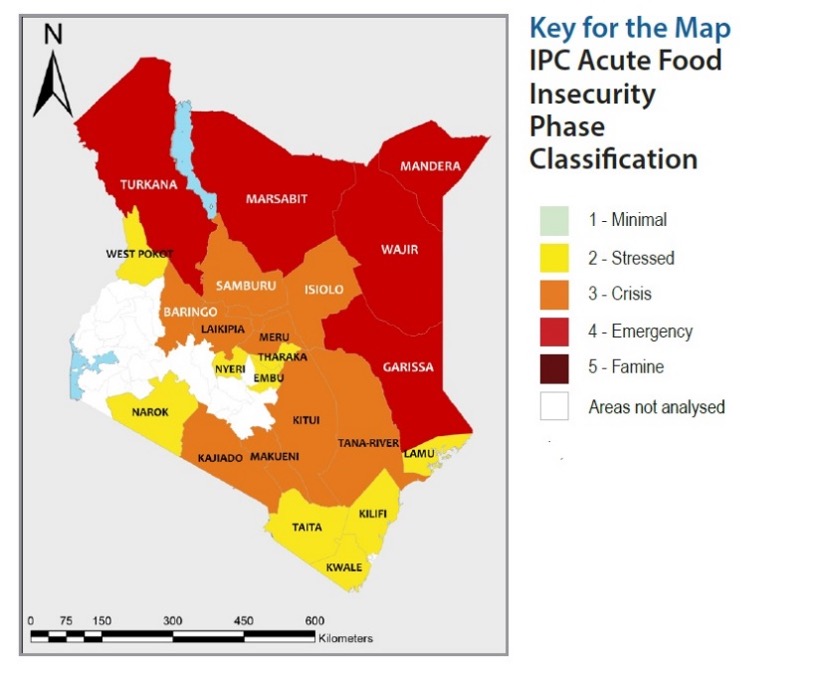
Map on IPC Acute Food Insecurity Phase Classification in Kenya
In addition, pests and diseases pose a serious threat to food security, with invasive pests like the fall armyworm, Tuta absoluta and desert locusts causing significant damage to crops. Poor infrastructure, such as inadequate storage facilities and poor transportation networks, also puts Kenya’s food security at risk by causing post-harvest losses and reducing access to markets.
Finally, inadequate policies and regulations to guide the food sector and inadequate investment in research and development may hamper the implementation of Kenya’s food security roadmap. The COVID-19 pandemic has had a significant impact on food security, leading to supply chain disruptions, reduced incomes, and increased prices of food items, particularly for the vulnerable population. Overall, addressing these risks is crucial for successful implementation of Kenya’s food security roadmap.